Showing posts with label operations. Show all posts

Saturday, December 17, 2016

Operations Versus Running with a Purpose


Switching the Fort Frances yard.


I have a confession to make: I really don’t like operations.

I don’t know if you are allowed to say that out loud. But it’s true.

For some reason, the idea of creating car cards or implementing a software program to govern the movement of every piece of rolling stock on the layout just never took hold with me.

I tried it. On my first layout, I conscientiously created cards for every car I owned. I labelled every industry and spur.

I gave it a valiant effort, but it just didn’t take. (I actually recycled all the old cards this year.)

With the M & M Sub., my second layout, I didn’t even bother trying.

But even though I didn’t want to do operations, I still wanted to run trains on the layout with a purpose.

That is, I wanted trains to run realistically, as if they were going somewhere. I also wanted a plausible reason for them to drop off and pick up cars in the main yard at Fort Frances.

At first, I tried the wheel report method, popularized by Jim Hediger. It worked fine, but even that proved to be more paperwork than I was interested in.


Since that time I have tried other simple methods, but lately have settled on a simple scheme where trains do pick-ups and set-outs in the yard.

That is, trains headed east and west drop off cars for destinations that originate I Fort Frances (Peace River, International Falls, the Peace River Mill, local), and pick up cars headed east or west.

The beauty of this scheme is that cars in the set-off/pick-up track don’t actually have to be delivered to a different destination.

When a train arrives, it can be assumed the cars in the pick-up track are ready to go, even if they were dropped off earlier and never delivered anywhere.

If I want, I can assemble them into trains for various locations and deliver them. Upon return, I can then put cars for set outs into place after doing some switching.

Switching the Peace River RR interchange.


Not prototypical, but it gives me a sense of purpose, and permits some action in the yard.

As for governing train movements, I do that on my easy-to-make dispatcher’s panel, which is located in the storage room above the dispatcher’s mainline panel.

In keeping with the theme of simplicity, I use it to govern a sequence schedule. All trains in the upper staging yard need to move to the bottom, and vice versa.
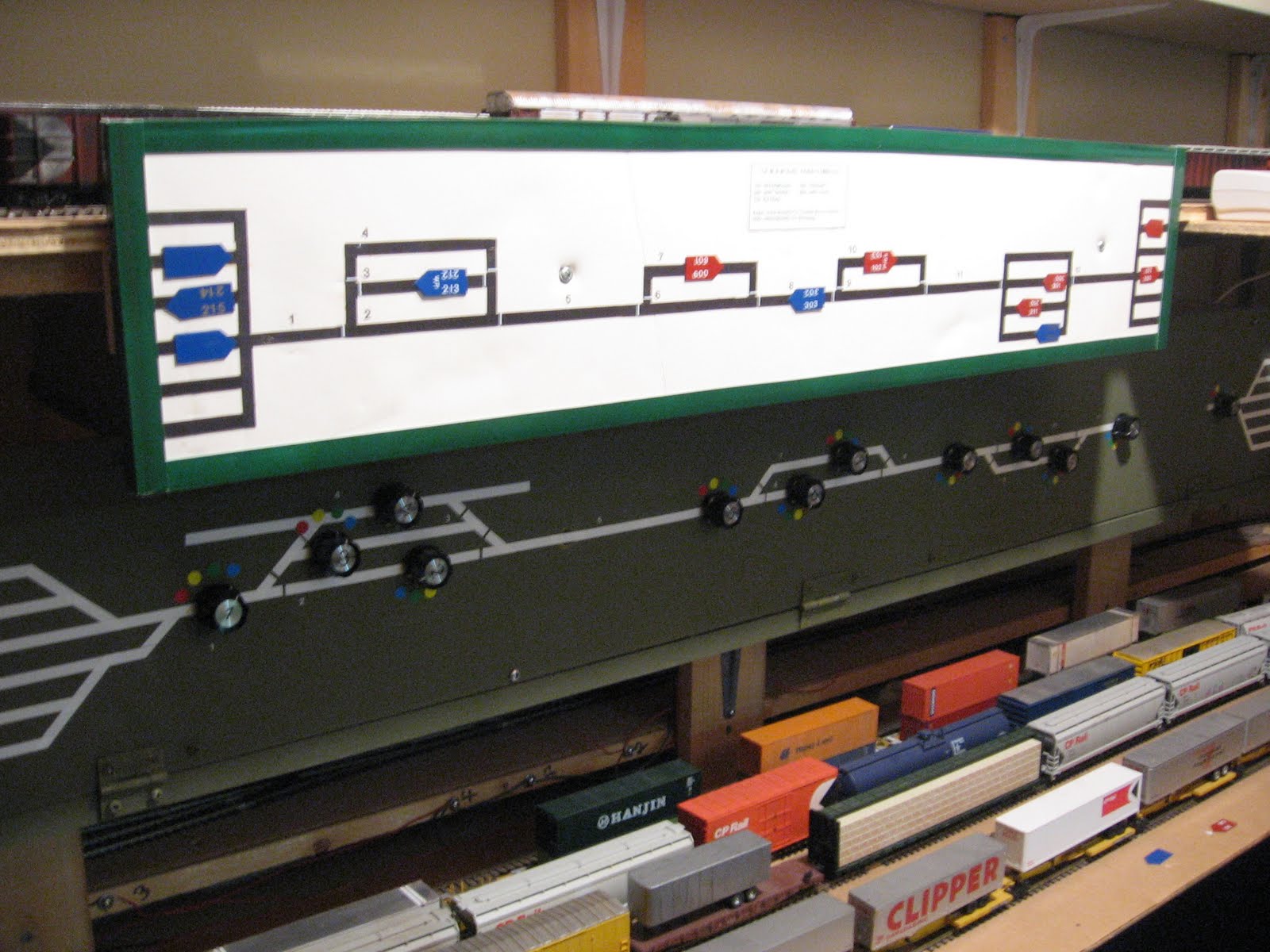


(In a sequence schedule, trains run in sequence. It can take two days, two weeks or two months to run them all sequentially.)

Or, to put it another way, the blue tags need to move to the bottom and the red tags to the top (or the other way around).

Again, the purists might have a heart attack. But it works for me.

Sunday, September 6, 2015

Use an Elevator to Connect a Multi-Level Layout


So here’s a neat idea for connecting the two levels of a layout: An elevator.

Most of us who have two-level layouts use a helix. But what if you are modelling ferry operations between two disconnected lines?

Then an elevator makes perfect sense.


The layout and elevator belongs to Bruce Barney. It was on display during the 2015 NMRA convention in Portland, OR.

Bruce's HO scale Arrow Lake and Western is a semi-freelance representation of CP Rail operations in southern B.C., including rail barge traffic on Slocan Lake, in the late 1960s to 1970s. 

The rail barge operation allowed CP Rail to serve isolated branches along Slocan Lake. 

Unlike other rail barge operations, where the cars are put on the barge by one locomotive and unloaded by another at the other end, the whole train was put on the barge and transferred by water.

The operation ended in the 1980s.

On Bruce's layout, once the ferry is loaded, it moves from the first level to the second level via the elevator, simulating the trip along the lake.


Click here to see a video of the elevator in operation.

The prototype in action.


More photos of Bruce's layout are below. Click here to visit Bruce's Portland NMRA convention page.


Thursday, July 30, 2015

Switching the Peace River Paper Mill on the Manitoba & Minnesota Sub.


A few shots today of switching at the Peace River paper mill.

In the photo above, the day's switching starts with the plant switcher pulling loaded and empty cars from the mill.


The loaded and empty cars (the tank car) are pulled out of the mill for spotting on the mill passing track. They will later be picked up by the Fort Frances yard switcher.


After pulling the loads and empties, the yard switcher starts spotting the new cars for the mill.


More spotting of cars. The cars ready for pick-up are waiting on the passing track.


A mirror makes the pulpwood tracks look longer.


When the mill switcher is finished, the CP Rail yard switcher brings in the next cut of cars for the mill.


Pulling into the mill.


After dropping off the new cars, the switcher backs on to the cut heading back to the yard.


It then pushed them back to the Fort Frances yard so they can be ready for departure on trains headed east and west.


Switching the cars into the yard.


Meantime, the mill switcher backs into the small two-track yard, ready for the next time it is needed.

The Peace River paper mill is a like a layout-within-a-layout on the M & M Sub. The small switching area, with its five spurs and nine spots, plus a run-around track, can occupy an operator for 20-30 minutes.

Read more about how I scratchbuilt the mill.


Sunday, July 12, 2015

Switching the Grain Elevator at Turney, Manitoba on the M & M Sub.


Moving in to pick up the loaded cars.


I was out driving in the countryside the other week when I happened upon a bit of switching at the grain elevator in Turney.

I didn’t have much time, but it was a pleasant diversion—and a good chance to take a few photos.

Turney is switched by the Nance turn, which interchanges cars with the Peace River Northern at Nance and switches the elevator on an as-needed basis.

(Turney is named after my friend Morgan Turney, editor of Canadian Railway Modeller.)

Bonus! A freight comes by.


A view of the overall scene.


The loaded cars are on the main; the empty is being spotted.


Leaving Turney with loaded cars in tow.


Monday, March 16, 2015

Wheel Report for Operations on the M & M Sub.


Two SW9s use the Wheel Report system to
switch cars in Fort Frances.


Model Railroaders use different systems to govern operations. I use a variation of the Wheel Report system on the CP Mail M & M Sub.

I first learned about the Wheel Report idea from an article by Jim Hediger in 1984 in Model Railroader. I like it because it requires no waybills, car cards or computer-generated switch lists.

A Wheel Report basically lets the operator do whatever he wants, while maintaining a semblance of realism.

In a Wheel Report system, there is only one piece of paper for each train. It tells operators how many cars are in each train, and blocks them by destination.

Another view.


The simplicity of the system lies in how it doesn't specify where cars go once they arrive at that destination. (That’s what waybills are for.)

The only rule of the Wheel Report is that the operator needs to pick up as many cars as are dropped off.

A typical Wheel Report for M & M Sub. mainline trains looks like this.

TRAIN: WPG-DULMX (Winnipeg-Duluth Mixed Freight)
LOCOMOTIVES: CP Rail 6027, 6023
NUMBER OF CARS: 18
BLOCKS: 1-13 Duluth, 14-17 Thunder Bay, 18 local.

At Fort Frances, five cars are dropped and five cars are picked up. Then the train makes its way off to Duluth (staging).

For locals, it would look like this.

TRAIN: Fort Frances Turn
LOCOMOTIVES: CP Rail 6027, 6023
NUMBER OF CARS: 8
STATIONS: 1 Ritchie, 5 Nance, 1 Turney.

Like what happens with mainline trains, the rule is to pick up as many cars as are dropped off. Which industry each car goes to is left up to the operator. 

(Common sense helps with the decision; a tank car would go to a refinery, and a hopper to a grain elevator.)

A local passes through Ritchie.


Whit Towers, of Alturas & Lone Pine model railroad fame (1917-1999), was one of the first model railroaders to operate his layout in a realistic fashion. He called the Wheel Report the “thinking man’s” car-forwarding system. I like that description.

For operational purists, this is far from perfect. In fact, it's probably down-right irritating. But for me it provides a relaxing, simple and paper-free way to operate trains in a semi-realistic manner.  

Read more about the Wheel Report system on the Gateway NMRA website. Got to the chapter titled Realistic Operations Phase 5.

Learn how the Little Rock Line, an N scale layout, uses Wheel Reports for car routing, including automating them with Excel. Examples of Wheel Report lists are included.


Thursday, February 12, 2015

Team Track on the CP Rail M & M Sub.


As model railroaders know, a team track is one of the most versatile industries on a layout.

A team track is a spur for businesses that do not have rail service. It got its name from the teams of horses that pulled wagons to the tracks before trucks were used. For some reason, the name stuck.

An team of horses puts the "team" in team
track in Duluth, MN.


There is a two-track team track in Fort Frances on the CP Rail M & M Sub. One of the tracks features a ramp for unloading truck trailers from piggy-back flat cars.


Cars which find their way to the team tracks include flat cars, box cars, covered hoppers and bulkhead flats.

Making the team track area was simple. I simply painted the upside-down ceiling tile I used for subroadbed black. I used cinders for ballast for the track, scattering some ground foam around to simulate weeds.

A black magic marker pen was used to simulate cracks in the asphalt.


Click here for an interesting look at team tracks in Duluth, MN from Zenith City Online. Old-time photo above from that website. 

Tuesday, December 30, 2014

Thoughts on Staging Yards


Upper staging yard on the M & M Sub.


The old adage holds that you can never have enough staging.

In the most recent issue of Great Model Railroads, Sam Powell disputes that. On his Penn Creek Valley layout he has four short staging tracks. He says it's enough for his layout.

The M & M Sub. has 12 staging tracks, each capable of holding a 20-car train. I'm about two tracks short of what I need.

(This is partly due to the removal of two passing tracks when I reduced the size of the layout. They functioned as open staging.)

Lower level staging yard.


One option would be to reduce the size of the fleet. I don't feel a deep need to do that; cars not on the layout are on shelves in the staging room.

At least I'm not adding rolling stock; I stopped most of my buying of model train items a few years ago.

My staging yards operate pretty simply: One train out, another in. The goal of an operating session (which can take days or weeks) is to move trains from the bottom staging yard to the top, and vice versa.

A simple dispatcher's panel that uses magnets to represent trains help me keep track of the traffic.

Best of all, the staging yards are out in the open, in a storage room beside the layout room. This room also contains the dispatcher's panels for all mainline movements.

Looking left, Thunder Bay/Duluth on bottom,
Winnipeg on top.


When mixed freights arrive in Fort Frances, they have cars taken off and added by the yard switcher. Unit trains (coal, intermodal, grain, forest products) just change crews.

Anyway, over the  Christmas break I've been running trains. I completed one session, or cycle, and then set the layout up for a new one. That meant putting locomotives at the heads of trains so they are ready for their next trips.

When that was done, I decided to take a few photos.

Now, if I could just figure out where to put two more staging tracks . . . .

Looking right. The "helix" that connects the
levels is between the two yards.


Click here to read more about staging yards on the M & M Sub.

Sunday, December 21, 2014

A Plugged Yard on the M & M Sub.

WPGTB (Winnipeg-Thunder Bay) departs as DULWPG
(Duluth-Winnipeg) enters a plugged yard.


This ever happen to you? Too many trains and too few tracks. That's what happened on the M & M Sub. the other week.

All three main and passing tracks in Fort Frances were filled, as was the station track with a private owner's train on a rare mileage run.

A view in the other direction.


That's when a mixed freight from Duluth to Winnipeg came in. Luckily, there is a back track in the yard which is used by switchers to run from on end to the other.

The yardmaster directed the new arrival to that track. Once it had cleared the main, the mixed freight from Winnipeg to Thunder Bay left., where it also had cars switched out.

After that, the train was sent on its way to Winnipeg.

Looking from the west end of the yard.


Saturday, February 8, 2014

Switching the Peace River Northern Interchange on the Manitoba & Minnesota Subdivision


A local arrives in Nance.


In an earlier post, I wrote about how the town of Nance is one of three "switching layouts" on the CP Rail M & M Sub. (Areas where operators can switch a variety of industries or spots independent of mainline action.)

In that post, I described how the local drops off and picks up cars destined for the Peace River Northern, a shortline that interchanges with CP Rail at Nance.

Depending on my mood, either nothing happens to those cars--they are simply picked up by the next local through, having presumed to be loaded or emptied during their sojourn in the the Nance area--or I actually swap them out for cars from the PNR.

When the latter happens, number 6, the PNR's old CP Rail GP7, comes out from behind the hill to perform its switching duties--as seen in the photos below.


No. 9 appears from the hidden track behind a hill to begin the switching assignment.


It couples with the cut of cars left in the small two-track yard. These cars are all bound for the paper mill. (See the industry that isn't there.)


It pushes the cars through to the tail track at the west end of the yard, leaving the string of cars it brought to Nance in the now-vacated track.


It pulls the new cut of cars past the cars it left in the Nance yard.


The PNR train heads back towards the mill (the industry that isn't there), seen in the background.


The view from behind "the stage" of the layout, as the PNR train heads into staging.

This was an easy switch; everything was bound for the paper mill. Sometimes cars left in Nance by the CP Rail local need to be switched into industries in the town. That complicates things for the PNR crew, which needs both yard tracks for passing (although it can ask for permission to use the CP Rail main, too).

Now there are four new cars ready to be picked up by the CP Rail local, the next time it comes to Nance.