Showing posts with label structures. Show all posts

Thursday, April 20, 2017

Winnipeg's Nutty Club Building Saved in Real Life, and on the M & M Sub.


Winnipeg’s Nutty Club building may become an official part of Winnipeg's heritage.

As the CBC reports, the city's historical buildings committee has nominated warehouse, formally known as the Scott-Bathgate Building, to be added to city's list of heritage buildings.

The five-story brick-and-stone structure on Pioneer Avenue was built in 1905, at the height of the railway boom, when Winnipeg was one of North America's fastest-growing cities.


Before making candy, the building was an important distribution centre for the east-west railway traffic that coursed through Winnipeg.

The city wants to protect architectural elements on all four of the building's external facades, as well as the ornamental tin ceilings and heavy timber on the inside of the warehouse.


I’m glad the Nutty Club building may be saved. But it has already been preserved on the M & M Sub.

Some years ago, I took photos of it, then enlarged them on a colour photocopier.

After cutting it out, I affixed it to the wall as part of the backdrop in my imagined town of Fort Frances, Ont.

It has a place alongside other old or disappeared buildings from the city—like the Five Roses flour mill and the Codville building.


Presented this way, as static stand-alone photos, the buildings don’t look very convincing, I know.

But seen on the periphery of the eye, while focused on a train moving through the foreground, they cause the brain to “see” a real building there—one of the ways our brains and eyes play tricks on us.

(See my earlier post on photography, titled The Ghent Altarpiece, Model Railroading and Seeing With the Brain.)

Anyway, like I said the Nutty Club building lives on on the layout—whether or not it remains in real life. Which it just might be able to do now.

Here are some photos of other buildings on the layout.


Saturday, June 11, 2016

Rewind: Model an Industry that Isn’t There

Peace River Northern #6 switches the "paper" mill .


If you do a blog long enough (this blog started in 2009), and post enough entries (over 750 to date), many posts slip way out of sight. Some of them might be worth viewing again, if they weren't so hard to find. Like this one from 2009, and others I will re-post in my new Rewind collection.

Over the past number of years there have been a number of articles in the model railroad press about modeling invisible industries.

These include tracks that run off the edge of the layout to a factory that is “located” in the aisle, or that run behind the scenery to another hidden plant of some kind.

The CP Rail Manitoba & Minnesota Subdivision utilizes the latter approach. In my case, it is a paper mill that is located off the layout.

That doesn’t mean it isn’t visible, though—it is, just above a ridge in the distance behind the upper level town of Nance.

And when I say paper mill, I mean “paper” mill, as in it is made of paper. It’s a photo of the Walthers’ paper mill, taken from an ad in Model Railroader.

I simply cut it out and glued it to the wall. A photo of a hill was cut out of calendar or magazine (I can't remember which) to complete the scene.

Operationally, locals that ply the line drop off cars in Nance at the interchange with the Peace River Northern, a shortline that serves the mill and other industries off the layout. (The PNR line, which is served by ex-CP Rail GP9 #6, sneaks off the layout, behind a small ridge.)

In reality, nothing happens; cars dropped off in one session or operating sequence become cars ready for pick-up in the next.

This industry that isn’t really there gives me another operational opportunity without actually requiring me to build another mill, or devote space to it.

Sunday, February 14, 2016

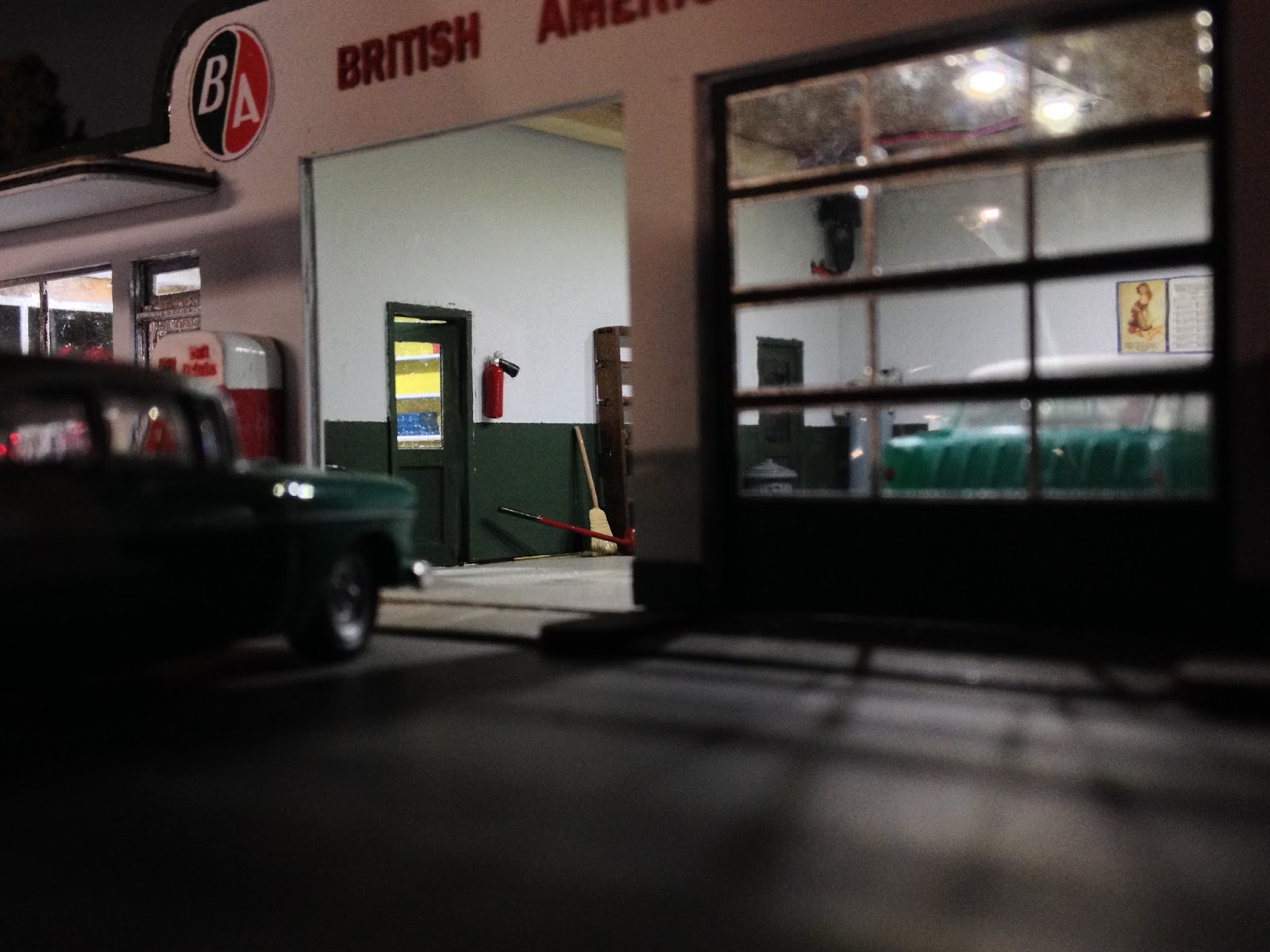
Great Gas Station Night Scene on a Great Canadian Model Railroad


One of Winnipeg's Great Model Railroads is owned by Walter Pankratz. 

The layout, which features the CPR in the 1950s, has many great scenes. One of the best is Walter's British American gas station.


The station, made from an Inter-Action Enterprises kit, lights up when Walter turns down the lights.

The kit comes with many details, but Walter added more, especially to the interior.

I'm sure you'll agree he has done a great job on this kit!


Click here to see more photos of Walter's great layout.


Saturday, February 6, 2016

An Easy (and Busy) Industry to Model


I’ve passed this industry dozens of times on the 401 when travelling from Pearson airport in Toronto to Kitchener.

I’ve often wondered what it was, and what was being brought in by the covered hoppers that are usually lined up outside the building.

So, this time, I decided to do a bit of research. And with some time between business appointments, I also went trackside to take a few photos, too.


The company is Katoen Natie, which is headquartered in Belgium. It provides logistics and other services to various industries in Europe and North America.

In Canada, Katoen Natie has branches in Edmonton, Montreal and Mississauga. This Mississauga location offers logistics for specialty chemicals—plastics used for packaging, boxes and bags.


I assume the covered hoppers lined up beside the building are bringing plastic pellets, and that they are unloaded pneumatically. The cars are delivered by Canadian Pacific.

(And thanks to Jurgen Kleylein, I now know that the pellets are stored in the cars until needed; no need for storage facilities in the building. This explains why there are so many hoppers there.)

For those of us modelling the modern era, an industry like Katoen Natie would be a great addition to a layout, what with having so many spots for cars in such a small area.


It would be simple to make with some cardstock, foam board and corrugated siding. You don't even need doors!

It could be modelled as a flat, with one, two or, in this case, three tracks beside it.


Too bad the CP Rail M & M Sub. is done. Maybe if I ever build a new layout, this could become a signature industry.

(Sorry about the trackside photos; the sun was on the wrong side of the building when I made my visit.)


Saturday, November 14, 2015

New Display in Memory of Jock Oliphant


One of Jock Oliphant's structures, on display
at the Winnipeg Railway Museum.


Not many people know the name Jock Oliphant—maybe a few model railroad oldtimers. But in Winnipeg, where I live, that name is well-known in the model railroad community.

Jock, who died in 2000, was Canada's first Master Model Railroader (MMR #15), and the only person to win best-in-show at three successive NMRA national conventions.


The former Winnipeg Model Railroad Club member  was renowned for his intricate and detailed structures. A number of his award-winning structures were incorporated into his layout.

At club meetings, he did an annual scenery clinic where he would demonstrate the steps to go from raw bench work to full scenery in 4 inch increments on a 4 foot long module.


According to WMRC member Dave Downie, Jock invited new club members to sit up front to get a really good view. This was a signal to older members to move back—Jock always sprayed those in the first row with water. 

His children decided to donate some of his structures to the Winnipeg Railway Museum, where they are now on display today in a temporary exhibit space.


I only met Jock once or twice, and never saw his layout. It’s great to see his structures on display at the Museum. 


Jock Oliphant

Monday, January 5, 2015

Mirror, Mirror on the Wall (and on the M & M Sub.)


The mirror makes it look like the tracks
go on and on . . . .


The legendary model railroader John Allen pioneered many innovations in the hobby, including the use of mirrors to make scenes appear larger.

Can you spot the mirror in Allen's
city of Port?


I don't have even a fraction of Allen's ability or artistry, but I, too, have a mirror on the Manitoba & Minnesota Sub.

In my case, it makes a couple of spurs at the Peace River mill look like they continue on beyond the layout room.


Since the tracks are tucked into a corner, behind a large mill building, the mirror isn't very noticeable. But a look in that direction enables the illusion.

Another of Allen's inventive mirrors.


Friday, December 12, 2014

Scatchbuilding and Kitbashing on the M & M Sub.


My first scratchbuilt building.


One of the things I enjoyed doing a lot when I started in this hobby was scratchbuilding.

My early efforts were terrible. And my later efforts weren’t prize winners, either. But it felt good to make something uniquely mine.

My very first effort was the warehouse in the photos above and below. It was made out of balsa wood. I scribed the siding with an X-acto knife. (It looks terrible.)


The roof is made out of cardboard, and the skylight features some of the opaque packing material that used to come with Athearn Blue Box locomotives.

It was designed to fit a particular place on my first layout. It never found a home on my new one, for a few reasons: First, it’s too small to be served by rail in the era I model (1990s). Second, it's footprint doesn't fit the new space.

But, most importantly, my skills have advanced to the point that it no longer is appropriate for use.  

Even thought I have no use for it, I haven't been able to throw it away. Every now and then I think I might like to resurrect it—put on new styrene siding and see if I can’t make it shine again. 


My second scratchbuilt building was the mine in the photo above. It also occupied a prominent place on my old layout.

When I built my new layout, it too was without a home. I gave it to my brother-in-law for his layout; he later sold it. I wonder where it is now?

I also made some wood crib elevators—prairie skyscrapers. The biggest one was made for a friend who wanted one for his layout. I posed it on my layout before he took possession.


That is the real Pioneer orange, by-the-way. I went to their head office and got a jar of it.

I've made other grain elevators, like this one, at Turney.


My biggest scratchbuilding project is the Peace River paper mill. It’s amazing what you can do with sheet styrene and foam core.


In addition to scratchbuilding, I also enjoy kitbashing. Sometimes I combine scratchbuilding and kitbashing—scratchbashing? Kitscratching?


None of my buildings are contest winners—those built early, or those built later. But they do the job, and building them provided many hours of enjoyment.

Since the M & M Sub. is basically done, I haven’t built any buildings—scratchbuilt or kitbash—for some time now. But every now and then I think it might be fun to build something again.

I still have lots of styrene, after all . . . .