Showing posts with label Gateway Spur. Show all posts

Saturday, December 12, 2020

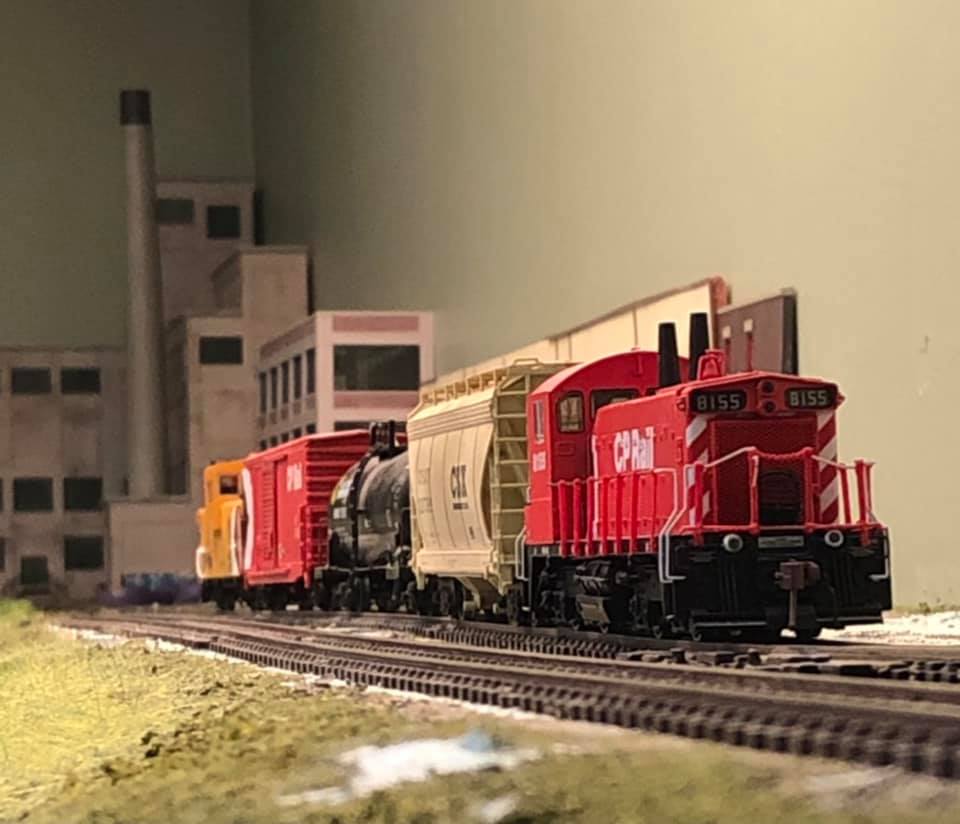
Progress on the Gateway Spur: Working at Weller Beer


Weller Beer is the first named industry on the layout. I’ve decided to name them after childhood places and streets in my hometown of St. Catharines, Ontario.

Weller Beer is named after Port Weller, the Lake Ontario entrance to the Welland Canal. It was located near my home; I spent many happy hours there watching the ships come and go.

 It’s the biggest industry on the Gateway Spur, with three tracks. Two are for inbound commodities of corn syrup and barley (tank cars and covered hoppers), and one with three spots for outgoing pallets of beer (boxcars).


There is also a team track beside the brewery, which can receive different kinds of cars.

Weller Beer is also the first part of the layout where I did some of the first scenery work—paint the tracks, ballasting and ground cover.

It’s still only basic, but it’s getting there. I will want to add more details, including lots of details to the structure itself.  


The backdrop is still an issue; it’s green! I have thought about backboard, or maybe I just don’t care. It’s about operating the trains. And I could get some software to add a sky for photos. We’ll see . . .


Wednesday, November 25, 2020

Back in the Train Room or, The Gateway Spur is Back


The Gateway Spur is back! Or maybe it’s more correct to say I’m back with the Gateway Spur. 

The layout never went away. But it has been dormant since March when the pandemic started. Somehow, I just lost interest in the hobby as the first wave of the virus swept North America. 

Then, when summer came, I spent most of my time outdoors biking and doing other things. I spent no time in the basement. 

Plus, there were plans to renovate the old train room—put in a new floor, paint and turn it into a spare bedroom/hobby/whatever room.


To get the room ready, I had to take down all the buildings for painting and put many other things away. 

But that’s all done now. I’m back working on the layout. It feels good. 

To reiterate (since it’s been so long since I last posted about it), the Gateway Spur is a short freelanced industrial layout along three walls of the room. 


It replaces the old CP Rail Manitoba & Minnesota Sub., after which this blog is named. In fact, it uses two sections of the upper level of the old layout; so, in a way, the M & M Sub. lives on. 

Set in the late 1980s, the idea behind it is seven industries (and team track) are located on a spur on the outskirts of a larger urban centre. They are serviced by a switch job that originates in the urban centre (fiddle yard) as an out-and-back operation. 

Train lengths are 4-5 cars, plus a caboose. 

Industries along the line are not yet fully determined, but so far I have a plastics business, a mill, a brewery, team track and several manufacturing companies. 


The brewery, with three tracks, is the largest industry on the line. 

I use a simple homemade card system to determine which industries get switched during each session. 

Over the past few weeks I’ve been troubleshooting the layout, getting things ready for scenery and ballasting. (There's still lots to be done to the buildings, including some repair.)

Unlike my previous layout, which featured a busy mainline with perfect track (or as perfect as I could make it), a little unevenness, crookedness and rocking-and-rolling by the train is perfectly acceptable on the Gateway Spur! 


One thing I haven’t decided yet is whether I will bother with a backboard for a blue sky. One of the compromises with “management” was going with the preferred colour for the room (green). I might get software that enables me to add a sky to photos. We’ll see. 

Also, the fascia will be painted a green trim different from the wall colour. That will have to wait until its safe to go to a paint store again. (We are in code red lockdown in Winnipeg now.) 


But I’m in no rush to finish anything; with such a small layout (compared to my earlier one, which filled the room and took decades to complete), it would be too easy to complete things. And then what? 

Slow as she goes is the watchword; sort of like how trains operate on the Gateway Sub. 

And maybe a bit of rocking and swaying, too.


Sunday, July 5, 2020

COVID-19, Model Railroading and the Gateway Spur


Like many other things during the pandemic, the Gateway Spur has been shut down.

Unlike the real world, it wasn’t loss of traffic or customers or supplies or even to prevent the transmission of the virus.

It was simple loss of interest and energy.

It’s not like I wasn’t busy at other things; as a religion reporter for my local newspaper, my work continued unabated as I reported about the impact of the pandemic on faith groups.


And the little NGO I work part-time for had to do all sorts of recalibrations to adjust to the new reality.

I also started biking more, an hour or so each evening to stay fit and keep my mind off the loss of so many things because of the (stupid) pandemic.

I also read 8 or 9 books—a record for me. In normal times, it can take me a month to get through one.

But in other ways, the pandemic really weighed on me. Sports, concerts, festivals and so many other events all cancelled. Even if I was never going to go to or take in them all, I felt their absence keenly.

It was a sort of existential loss, a void that seems to last forever.


This lack of energy carried over to model railroading, I found it hard to be motivated to do anything on the layout.

I went down to the train room only a few times to run some trains—never mind think about doing scenery.

For me, the energy for the hobby just wasn’t there. Or for this blog, which I haven’t updated since April 22.

Am I the only one who felt this way?

I know some haven’t. People like Jason Shron of Rapido Trains has used the time at home productively to make some brilliant scenery on this layout. 


Which is amazing, considering he was also trying to keep his company afloat and keep three kids busy at home at the same time.

Others on the Canadian Railway Modellers group have posted photos of their modelling during the pandemic.

Since he’s in the higher-risk age group for catching the virus, Kevin Day stayed inside completed two kits he bought about 35 years ago.


Jon Calon of Calgary found a silver lining in the pandemic, noting a lot of sign shops and places that produce the clear sneeze guards are likely to be awash in scraps of material.

"Those scraps work wonderfully for model railway owners wanting to protect details and rolling stock close to the edge of the layout," he wrote.

"I just scored (free!) a couple of 8' long chunks of clear polycarbonate that are about 10" tall." 


Daniel Charest used the lockdown to add a mine to his N scale layout. This area was a piece of plywood before the pandemic started.

Nick Eh used the "COVID crap" time, as he called it, to model CP GP38-2 3031, a unit that brought back good memories from when he was a kid.


And good on John Strickland and the Mississippi Valley Associated Modelers in the Ottawa area found a way to combine social distancing with running trains by setting their modules up outside.


As for me, maybe things will change in fall modelling-wise. Summer always was a slow time, anyway. Perhaps things will be different in the fall for the pandemic and my energy. We can only hope.

Sunday, March 8, 2020

Great Help for Designing and Building a Shelf Layout


Soon after taking down my large (17 by 21 foot) double deck (at one time triple-deck) layout, I joined three Facebook groups dedicated to shelf layouts—like the one I am building now.

My goal was to pick up some ideas, get some encouragement, maybe even show off a bit of my work.


Micro/Small layouts is a group is for anyone who doesn’t have a spare room or basement to devote to a layout. (Which isn’t me, but they still let me join.) People don’t need a layout to participate.

HO Scale Shelf Layouts defines a shelf layout as something that utilizes a narrow shelf of various depths and may or may not be supported by legs. It is linear in design and could be around the room or along the walls. (That is more like what I am doing.)

And Shelf Layouts, Switching Layouts and Layouts for Small Spaces is pretty much just what it says in the title.


It was a great decision to join, for the following reasons. 

First, it reminded me again of how great these Facebook groups are (even if you, like me, am ambivalent about Facebook and its growing power over our lives).

Unlike model railroad magazines, which only show the best layouts in North America (or other countries), Facebook groups are open to anyone of any skill. You get to see such a wide variety of modelling, from beginner to expert.

Everyone is welcome, in other words.

Second, model railroad magazines devote their precious real estate (pages) to finished layouts—you aren’t going to see lots of photos of layouts under construction. But Facebook enables people to post photos at all stages of the process. You can learn a lot by seeing benchwork!

Third, the modelling comes from all over—Canada, the U.S., the UK, Europe, Japan. It is great to see so many different styles.


Fourth, the groups allow people to ask questions. Some people show the space they have and ask others for ideas—and get them. And some modellers, like Rob Chant of The Journal of Model Railroad Design blog, post plans and suggestions on the Micro/Small Layouts group.


Fifth, what a creative bunch model railroaders are! Some of the layouts are just tracks in boxes. One folds down from the wall. 


Others are one switch, a spur and an industry—all the space someone had. Some people make intricately-detailed dioramas.


The need to build a layout of any size or kind is strong—and many people are up for the challenge, if the meaning of the word “layout” is stretched in different ways.


These groups (there may be others) have been very helpful and inspiring to me as I created my new Gateway Spur, an HO scale switching layout. You might enjoy them, too.