Showing posts with label Layout. Show all posts

Saturday, July 27, 2019

Tibetan Sand Mandalas, Model Railroading and the Transitory Nature of Life (and Layouts)

First load in the garbage bin.


Back in 2009, when I was still building the M & M Sub., I got to thinking about the impermanence of all things—like layouts.

Specifically, I wrote about Tibetan sand mandalas and model railroads, and what they have in common.

Sand mandalas come from the Tibetan Buddhist tradition. Monks and devotees spend weeks or months creating them, making amazingly intricate images out of millions of grains of coloured sand.

When done, the mandala is admired and then ceremonially destroyed—swept away to symbolize the transitory and impermanent nature of material life.

Just like a model railroad.

A sand mandala.

In my case, the ceremony, such as it was, was a quiet final run on the layout (after having some friends over for a final time).

And then the dismantling began.

As I wrote back then, and am living now, a model railroad will not last forever. That includes the M & M Sub., which looks so permanent.

But with time, and taking out a lot of screws, it will be gone.

And that, not to sound all eastern and mystical, is the way of all life, and of all model railroads.

And even though I knew the M & M Sub. would one day end up as a pile of lumber on the floor, I wasn’t deterred.

Like monks making a sand mandala, I happily and carefully laid track, ballasted, planted trees, erected buildings and so many other things that gave me joy and a sense of accomplishment.

And now, the layout will soon be completely gone. I will mourn its loss. But I will also remember the times spent building it, and running trains.

And learning anew a lesson or two about the transitory nature of life.

Monday, July 22, 2019

End of the Line for the CP Rail Manitoba & Minnesota Sub.


It’s the end of the line for the CP Rail Manitoba & Minnesota Sub.

Not this blog; I hope to keep it going for awhile yet! I’m talking about the layout which the blog is based on.

In a year or two, we expect to move to a smaller place. The kids are grown up and moved out, and we don’t need such a large house. (As nice as it is.)


So rather than rush to tear down the layout, I’m taking my time this summer to take it apart.

I hope to leave up a section of the upper level along two walls to build a small industrial shelf layout; got to have something to work on!

This isn’t the first time I’ve dismantled a layout; I did it in 1994 in our previous house, when I tool down my 12 x 18 CP Rail Grimm Valley Sub.


(Interestingly, as the photo above shows, it was almost 25 years ago to the week that my first layout had its last run.)

And in 2010 I tore down the three-level centre peninsula of my current layout, a several-year process to create a single level portion in the middle of the room.

But now, after 25 years, the whole layout is disappearing. It’s sad, but it’s also time.


Before . . . 


During . .  . 


Truth is, I’ve been spending less and less time in the layout room of late. I always enjoyed running trains from time to time. But those times had become less frequent.

So I’ve been preparing myself psychologically for this day for a number of months. Doesn’t make it any easier, but it helps with the resolve.

In preparation for the tear-down, I had some friends over for a last time. Then, on July 19, I did a final run—just me and my memories as I watched a train traverse the layout for the last time.

Then, a day later, the dismantling began.


Over the next few posts, I’ll talk a bit about what it’s like to dismantle a layout, and what the layout has meant to me.

In the meantime, enjoy the photos of the last run.


Monday, October 22, 2018

Update: The View Outside My "Office" Window

View from my "office" window.


UPDATE: Since first publishing this in 2011, I have returned to working from home. So now I can be back in my office with the great view of passing trains.

I was visiting the office of a client last month near Toronto. Her office overlooked the CPR mainline. Got to admit—it was tough to keep my mind on our meeting every time I heard that familiar rumble of an approaching train.

It made me think: Wouldn’t it be great to have an office window like that?

In fact, I do have an office window that is like that—sort of. The decision to downsize my layout led to some losses, but also to some gains.

My office . . . .


One of the gains was room for my office in my train room. My desk now sits under part of the layout; as I work I can be pleasantly interrupted by passing trains every two minutes or so on the lower level. (The lower level of the layout is a loop.)

A video of what I see when I look outside my “office” window can be found on my YouTube channel by clicking here. Sit back and enjoy the view!

Friday, September 1, 2017

Tony Koester, Multi-Deck Layouts and Me


So I was re-reading a copy of Tony Koester's book Desiging and Building Multi-Deck Model Railraods, when I came across a couple of paragraphs about me.

Well, not about me exactly, but about the Manitoba & Minnesota Sub., and how it (and my late brother-in-law's layout) influenced Tony to build his own multi-deck layout.

Tony was a guest presenter at 2000 during the NMRA Thousand Lakes Region Millennium Express convention in Winnipeg.

During the convention, he visited local layouts—including mine and the Cougar River Subdivision, owned by my brother-in-law Ken Epp.

I don’t remember much of what Tony said during the visit, but I remember he paid me a compliment on my modeling. It meant a lot to me.

What I didn’t realize, until I re-read the book recently, was that his visit also caused him to take a dramatic turn in his own modelling.

In the introduction to the book, Tony wrote that for a long time, he couldn’t see himself “adopting the multi-deck approach to layout design any time soon.”

Then, in 2000, he came to Winnipeg, and got “quite a surprise.”

“During an extensive layout tour, I discovered that every new or newly revised model railroad on the tour had multiple decks! 

"One huge basement layout had at least three decks, in fact, with the upper one above eye level . . . something was clearly in the wind.”

Four levels on Ken Epp's Cougar River Sub.


“The story of what was in the wind is what this book is all about.”

“It’s as much a fascinating story of the recent history of progressive model railroad design as it is a how-to book.”

Three levels on the M & M Sub.


After reading those lines, I wrote Tony about his comments.

“That visit to Canada was indeed an eye-opener,” he replied, adding that Canadians seemed to be starting a trend.

Two levels on the M & M Sub.


As for the book itself, there’s a photo of the M & M Sub. in it. There is also a photo from the layout in another of Tony’s books, Model Railroading from the Prototype to Layout.

One of these days, I want to see Tony’s Third Subdivision of the Nickel Plate Road multi-deck layout, and see him once again in person.

Meantime, I can reflect on my tiny contribution to that great model railroad.

Tony's NPR layout.


.

Thursday, August 17, 2017

On the cover of the Rolling Stone, er, Canadian Railway Modeller


Back in 1972, Dr. Hook and the Medicine Show released a song asking to get on the “cover of the Rolling Stone.”

In 1973, they made it—in caricature, at least.

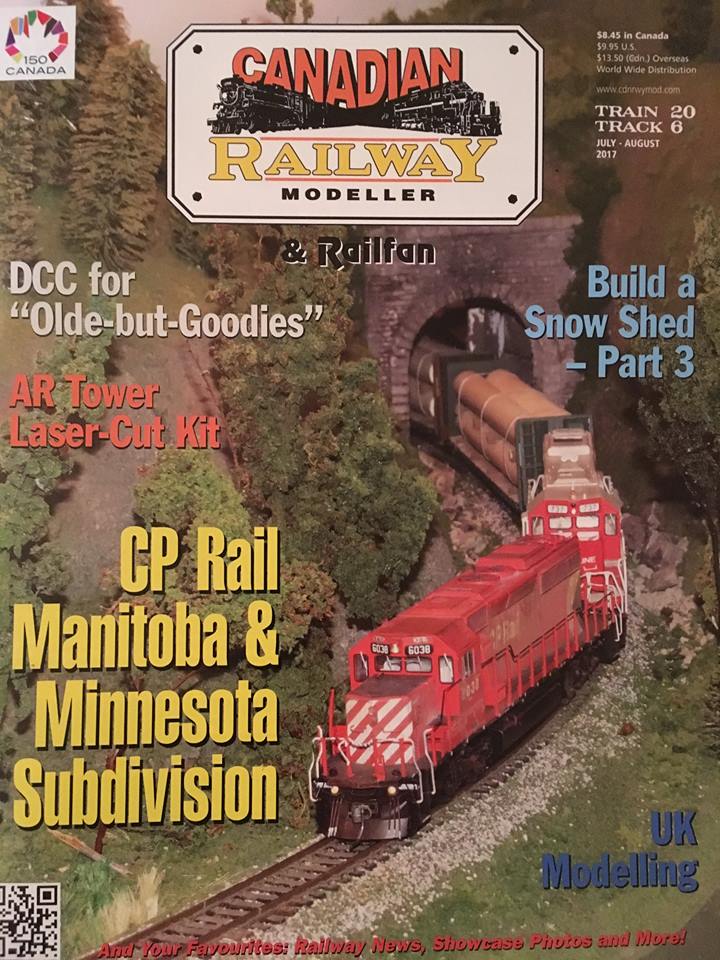
I have no aspirations for the cover of that magazine, but I was interested in getting the Manitoba & Minnesota Sub. on the cover of a model railroad magazine one day—and now it’s happened.

This summer the layout made the cover of Canadian Railway Modeller. It had appeared in the magazine before, but not on the cover.

The article inside describes the layout—its construction, background and operation.

In this Internet age, magazines are becoming old technology. But there is still something satisfying about getting in a printed publication—especially on the cover.

If you don’t believe me, ask Canada’s Prime Minister. 


Tuesday, August 15, 2017

Original Founding Document of the M & M Sub. Found


England has the Magna Carta (1215).

America has the Declaration of Independence (1776).

France has the Declaration of the Rights of Man and of the Citizen (1789).

And the CP Rail Manitoba & Minnesota Subdivision has the bill of sale from Bobbye Hall’s Hobby House in Dallas, TX (1987).

I know this, because I found it the other day.

I wasn't looking for it; I was going through a filing cabinet looking for an old warranty when I came across an archive file.

There were a number of keepsakes in there—bills of sale for our first few cars, our first house, things like that.

Also in the file—thanks to my wife, who hangs on to these things—was the handwritten bill of sale for the first model railroad equipment I bought 30 years ago when I got back into the hobby.

Dated May 25, 1987, it was just before we left Dallas after living there for two years to head back to Manitoba.

Before we left, I went to Bobbye Hall’s, a legendary Dallas model railroad store, and bought six pieces of rolling stock and a locomotive for $39.64.

(You heard that right, young people—you could do that back.)

As I have written before, I had been into trains since a young child but sold my N scale stuff in 1976 before leaving for college.

It was 11 years before I got back into the hobby, with a trip to Bobbye Hall’s.

And now, 30 years and two layouts later, here is the founding document of my model railroad journey.

All but one of those original items are long gone now. But through this old bill of sale, I can remember when it all began.

Friday, July 7, 2017

Alpha and Omega on the M & M Sub.


2017 marks 30 years since I got back into model railroading.

I had liked trains my whole life up to that point, starting with Lionel as a kid before moving to Tri-Ang, HO, and then N scale.

I sold my N scale stuff in 1976 before heading off to university and a more unsettled life that took me to Manitoba, B.C., Europe and Texas.

It was in Texas, in 1987, 11 years later, when I got back into the hobby. I had $50 to spend on some trains before returning to Manitoba.

I went to the late and great Bobbye Hall's model railroad store in Dallas, where I lived. (It was described in 2001 by the Dallas Observer as "the best hobby house owned by a 92-year-old woman who still comes to work every morning at 9.") 


I bought a locomotive and eight or nine freight cars—yes, for only $50 (you could do that back then).

Of those items, only one piece of rolling stock remains on the M & M Sub.: SHPX 60751—Stauffer Chemical Company. The others were sold or "scrapped."

In the Greek alphabet, alpha is the first letter, and omega is the last one. So SHPX 6071 was among the first of my current model railroad possessions, and also the last from that time. And it is also the last in line on DUL-WPG MX (Duluth-Winnipeg Mixed) on this July day, 30 years later.


Tuesday, July 4, 2017

A Little Bit of July Railfanning


Getting ready to leave the yard


Sometimes I want to write a post; other times, I just want to share some photos. This is one of those times—a bit of railfanning on the M & M Sub.

Come along as I follow a train from Fort Frances, Ont. to Nance, Minn.


And arrived at Nance.

Thanks for coming along for the trip . . . .

Sunday, January 8, 2017

Frozen in Time


Up here in the Great White North, we might be frozen, but not forever—not like the Manitoba & Minnesota Sub. in my basement.

We have had a lot of snow this year in Manitoba; more than in the past few years, that’s for sure. And now we’re in the middle of a really cold spell—minus 20 and below (Celsius).

But on the layout, it’s always summer, and always the early 1990s. 

Frozen in time, in other words.

It’s also frozen in time in another way, as I explained to my friend, Sheldon, who visited today. (The reason for the crossbucks in the snowbank—to help him find my house).

A trip to the M & M Sub. is literally a trip back in time, in two ways.

First, it's figuratively a trip back in time to the early 1990s, a time when CP Rail's trains were mostly pulled by the ubiquitous SD40-2 units.


It was a time when you could see a variety of liveries on those and other units: Multimark and no Multimark, Twin Flags, SOO (white and red and only red), and others (e.g. ex-UP and primer red and grey).

It's also a literal trip back in time to the early 1990s, when DC was the only way to operate trains, and Blue Box Athearn locomotives were considered among the top of the line model railroad locomotives..

Yes, that’s right: For those of you who might be new to the blog, the M & M Sub. uses DC (Dinosaur Control) and block controls.

In the early days, it was a matter of money. I didn’t have much, and it was too costly to convert to DCC.

Now, money isn’t as much of a problem, but I still don’t feel the need to change over from DC.

Although I can run up to four trains, I mostly run the layout by myself, so there’s no need to worry about needing to have multiple units running at the same time.


Plus, it's getting near to the end of the life of the layout; in another year or two, I figure, we will probably downsize to a condo or apartment.

Then the M & M Sub. will meet the fate of all layouts, coming down as they all must—part of the great Mandala of time.

Upgrading to DCC at this point would be foolhardy, then, if all I might have in the future is a small switching layout with a locomotive or two.

But until then, I will continue to enjoy the M & M Sub., even if it is frozen in time.


Monday, January 2, 2017

Helix, Nolix, Ovlix and—Rectix?


The "rectix" on the M & M Sub.


I was visiting the website of Brian Keay’s great Wolverine Lynx model railroad when I came across a word I hadn’t seen before: Ovlix.

On Brian’s layout, an ovlix is a version of a helix that is in the shape of an oval (oval + lix equals ovlix).

Brian's "ovlix"


I immediately recognized the concept, since it is similar to the way trains traverse between the lower and upper levels on the Manitoba & Minnesota Sub.

On my layout, I also employ something that looks like his ovlix and does the job of a helix.

In my case, it goes around a 5 x 9 foot storeroom that also houses my upper and lower staging yards.


It’s like an ovlix, but larger. So maybe I can call it a rectix (rectangle + lix = rectix).

(Because the size of the room, I can't actually get far enough back to take a photo of the rectix. Plus, it is mostly hidden on one side and both ends.)

I think Brian is on to something, and maybe I am, too. In addition to the traditional helix (a circle of track that connects levels) and a nolix (where the track rises around the walls of a room, as on Bill Darnaby’s Maumee Route and Tony Koester’s NKP), we can now have words like ovlix and rectix.


They may not catch on as words of the year, like “post-truth” in 2016, “emoji” in 2015, and “vape” in 2014, but maybe they’ll take off in the model railroad world.