Showing posts with label Ruminations and Reflections. Show all posts
Monday, February 16, 2015
Friends Visit the CP Rail M & M Sub.
It's Louis Riel Day in Manitoba, a Monday off to celebrate the man who is considered the founder of the province--and the man who was hanged by the government of Canada in 1885 as a rebel.
Who says we don't have a colourful history in this country?
It was also a day to welcome some friends to the CP Rail M & M Sub. The gathering was occasioned by the visit of Rapido Trains founder and owner Jason Shron to Winnipeg.
(Maybe one day Canadian model railroaders can designate a day to celebrate the founding of this unique company. I wonder what day would be best? What would we call it? And how would we celebrate it? Jason would have an idea or two . . . .)
Anyway, eight of us ran trains and talked about the state and future of the hobby, and a few things in between.
We even managed to pick up a wayfaring stranger from Toronto who was supposed to be headed back to that city today on VIA; a derailment forced him to fly home. Somewhere along the way he met Jason, and was invited to come along.
In the photo above are Ray Goy, yours truly, Jason (the VIA T-shirt is a give-away), Canadian Railway Modeller founder and editor Morgan Turney, Walter Pankratz, Matt Soknacki (the wayfaring visitor from Toronto), Christopher Robinson and Ed Pankratz.
Even though there are a number of lone wolf model railroaders, ours is also a social hobby. I enjoy sharing it with friends.
Sunday, February 8, 2015
Murphy's Law and Model Railroading
A friend came over last night to run some trains with me. The last time I
operated the layout, about two weeks earlier, everything ran flawlessly.
An hour before he arrived, I ran a test train. Darned if it didn't keep
derailing at the same spot on the swinging gate that spanned the entrance to
the layout room.
After a bit of fiddling, I got it fixed. As I did, I thought: Murphy
strikes again!
Yes, good old Murphy's Law: If anything can go wrong, it will, and at the worst time posible.
Murphy's Law is one of those things that helps us make sense of this crazy, weird world.
The law of gravity explains why a heavy object falls
to the floor, but Murphy's Law explains why it always hits your foot on the way
down and then rolls to the most inaccessible part of the room.
Or, to put it in model railroad terms, gravity is why a locomotive falls to
the floor if there is a derailment near the edge of the layout.
Murphy explains
why it is always your most expensive locomotive--the one you superdetailed--and not
that old Blue Box Athearn you no longer care about.
As a corollary, Murphy also explains why such an accident never happens
when you are alone, but only when there is a crowd of visitors from the local
model railroad club.
As it turns out, there is an official Murphy's Law for model railroading.
Called Bye's First Law of Model Railroading, it goes like this:
"Anytime you wish to demonstrate something, the number of faults is
proportional to the number of viewers.
Bye also has a Second Law of Model Railroading:
"The desire for modeling a prototype is inversely proportional to the
decline of the prototype."
I found a number of other unofficial laws on the Web, which many of us
will recognize.
"Soon after you scratchbuild or kitbash a model that has never been
produced before, a manufacturer will announce a run of it."
"The number of derailments on your layout varies as the square of the
number of visitors."
"The chances of losing something are inversely proportional to the a) size, b) importance of the thing that can be lost."
"Parts fit perfectly together until you add glue."
"If you lose a part to a model, you will not find it until you order a new
part to replace it."
"The chances of losing a part are inversely proportional to the ease with
which you can replace said part." (To which the poster added this mathematical
formula: Pl - Pr/Pr + Pl = Dammit!!!)
"If a kit comes with several of the same part, you will never lose one. If
it comes with only one, the probability of it falling off the work bench and
disappearing forever are magnified."
"The most inaccessible place on your layout is the place where most of your
derailments will occur."
"After saving up your money to purchase a brass model you've been waiting
for, somebody will offer it in plastic at a fraction of the price."
Any other laws to add?
Saturday, November 8, 2014
Week of Remembrance: Britain's Railways During World War Two
It will soon be Remembrance Day (Nov.11), also known in the U.S. as Veteran’s
Day.
When we think of Remembrance Day, we usually remember the
men and women who fought, were wounded and who died while serving in the armed
forces.
We don't normally think of those who also made a valuable contribution to the war effort in World War II—those who worked for railways.
During this year's Week of Remembrance, the CP Rail M & M blog is highlighting the men and women who kept the trains running inEngland during that war.
We don't normally think of those who also made a valuable contribution to the war effort in World War II—those who worked for railways.
During this year's Week of Remembrance, the CP Rail M & M blog is highlighting the men and women who kept the trains running in
Keeping a railway running is hard enough in normal times; it is extremely difficult
when the enemy is bombing rail lines, trains, stations and shops.
As is pointed out in the BBC TV program British Railways in
World War Two (see links below), one of the Luftwaffe’s “main objectives was to
cripple Britain’s railways, and so paralyze the movement of troops, raw
materials and munitions. Suddenly, every railway worker in Britain found
themselves on the firing line.”
It was a costly war for the railways, in terms of men and material. During the war, 395 railway staff were killed and 2,444 injured by enemy action. About 450 locomotives were destroyed or damaged, along with many pieces of rolling stock and other infrastructure.
Says author Michael Williams in the book Steaming to Victory: How Britain's Railways Won The War of the men and women who worked for Britain’s railways: "Their courage and sheer hard work in getting trains moving again after the bombs had fallen was
legendary."
Williams praises all who kept the trains running, noting that "the bravery of people who kept the rains running during the Blitz was all the more impressive since railway operating staff in one respect worked under worse conditions than the armed forces."
Men fighting in battle, he notes, would only be at the front line a number of days before beling relieved. "This was never the case with the railways, whose staff kept passengers, troops and strategic supplies moving day after day, regardless or weather, air raids or anything else that could go wrong."
Many railway staff, he says, "worked and died under combat
conditions."
As if this were not enough, they could return home after a long, perilous shift to find their house had been bombed and their family killed or injured.
Meantime, the shops had to keep locomotives and rolling stock in running condition, despite being under attack.
As if this were not enough, they could return home after a long, perilous shift to find their house had been bombed and their family killed or injured.
Meantime, the shops had to keep locomotives and rolling stock in running condition, despite being under attack.
When the war was ending, then Prime Minister Winston Churchill paid tribute to
the men and women of the railways:
"Results such as the railways have achieved
are only won by blood and sweat. I express gratitude to
every railwayman who has participated in this great transport effort contributing
so largely to final victory."
Other Links
1. BBC TV British Railways In World War Two. ( A four part series on
YouTube.)
2. From Rail News: Seventy Years Ago: Railways At War.
3. British National Railway Museum: Rail Story of Victory in Europe.
4. A Bristolian Train Driver Recalls World War Two.
Other Week of Remembrance posts in this series
2. From Rail News: Seventy Years Ago: Railways At War.
3. British National Railway Museum: Rail Story of Victory in Europe.
4. A Bristolian Train Driver Recalls World War Two.
Other Week of Remembrance posts in this series
2013: The Canadian Pacific Railway's "Angel of Victory" Memorials.
2013 II: A War Memorial on a Model Railroad Layout.
2012: Canadian Railway Troops in World War One.
Monday, September 8, 2014
Future of Model Railroading
What's the future of model railroading? That question gets asked frequently on model railroad forums.
Answers vary. Some people are optimistic: The hobby has never been better! Others are pessimistic: It's going to be gone in a generation.
Me? I'm somewhere in the middle. I don't think it will disappear, but I think it will change.
I am not given to making predictions, but here's a guess I will hazard: In the future, there won't be as many large home layouts. Instead, there will be more smaller switching layouts.
Why do I think this will happen? Two reasons.
First, people are more mobile today. They move a lot more. It's hard to build a big home layout if you expect to relocate frequently. A small switching layout could be taken on the moving truck, though.
Second, the prices. I was in hobby shop recently. I saw rolling stock that cost between $75 to $100 (Cdn) each. Many were between $30-$50. Locomotives? $200-$300 is normal.
Do I think people will stop buying rolling stock and locomotives at those prices? No. But they will buy fewer of them.
Which brings us back to switching layouts. A modeller could build a fine switching layout with one or two locomotives and 10-20 cars and have a great time. That's all he or she would need.
Between mobility and prices, I think that's where model railroading could go--smaller layouts and fewer locomotives and cars. That's my guess for the future of model railroading.
Photo above: The Gateway Central HO scale switching layout.
Friday, August 22, 2014
Carstens Closes: No Man, or Model Railroader, is an Island
UPDATE: On Aug. 28, Railroad Model Craftsman and Railfan & Railroad were purchased by White River Productions. Click here to read more.
No man is an island entire of itself; every man
is a piece of the continent, a part of the main;
if a clod be washed away by the sea, Europe
is the less, as well as if a promontory were, as
well as any manner of thy friends or of thine
own were; any man's death diminishes me,
because I am involved in mankind.
And therefore never send to know for whom
the bell tolls; it tolls for thee.
That poem, by English poet John Donne (1572-1631), came to
mind when I heard that Carstens Publications is closing.
Carstens is publishers of Railroad
Model Craftsman and Railroad & Railfan, two publications I have come to enjoy.
(I am proud to say that my layout has been published twice in RMC.)
Already, online forums are replete with comments from those
who say: "Who cares? I get everything I need on the Web." And it's
true; many of us do get lots of information about model railroading online.
But not all; there are many who still prefer a paper
publication, even if that number is declining. I hope, especially for their
sakes, that a buyer for RMC can be found to keep it going.
But even apart from that, the loss of RMC is a loss for the
whole hobby. Just as "any man's death diminishes me," so to the loss
of a publication like RMC makes the whole hobby poorer and less vibrant.
It's true that there are lots of websites and videos that
can show you how to do just about anything in model railroading these
days.
But, as with most things, you get what you pay for; with
RMC, and with other publications, you could at least be assured that someone
had vetted and edited the article, and made sure it was worthy of passing on to
readers.
So even if you didn't read it, we all should acknowledge
the contribution RMC made to model railroading, and acknowledge the hole its
passing will leave for all of us--subscribers or not.
The last report I heard is that there are people who are interested in buying RMC; let's hope that happens. We will all be better for it being around.
Click here to read another reflection on model railroad magazines from an earlier posting on this blog.
The last report I heard is that there are people who are interested in buying RMC; let's hope that happens. We will all be better for it being around.
Click here to read another reflection on model railroad magazines from an earlier posting on this blog.
Saturday, December 14, 2013
Winnipeg's Oldest Home Layout Gone
| A scene on the Malamute & Klondike |
Back in 2010, I wondered what the oldest home layout in my hometown of Winnipeg was.
After a bit of research, I discovered the oldest layout--by which I meant the oldest layout in the same home and in the same basic condition as when it started--was 60 years old.
I didn't mention the owner's name, but it was Don McKinnon. He started his HO scale Malamute & Klondike layout in 1950.
Over the years, he changed things and added sections, but the layout still occupied the same place in his basement, with original elements intact.
![]() |
| One of Don's cars on the M & M Sub. |
Don died earlier this year; this summer, his layout was dismantled. The oldest layout, at 63 years, is gone.
A piece of it lives on on the M & M Sub. I won't run it in regular service; it's too old for my early 1990s time frame. But it will be a memory for me of Don, and the Malamute & Klondike.
Now the oldest layout in Winnipeg is one that was started in 1968. The next oldest was begun in 1969.
Compared to them, the Manitoba & Minnesota Subdivision is pretty young. Next year it will mark its 20th anniversary.
As I noted in that earlier blog, we will likely never see layouts that old again. Today, people are much more mobile; the chances that Canadians will stay in the same house for 65 years, as Don did, are remote.
But here's to the Malamute & Klondike, now gone like so many others, but living on in memory.
Thanks to Don's friend Marvin Fetch for the photos.
Wednesday, December 11, 2013
Last Layout
I think that every model railroader who has built a layout remembers their first one. Mine was a on a 4 by 8 sheet of plywood in my boyhood home.
First layouts--like other firsts in our lives--live on in memory, often bathed in warm nostalgia. But what about the last layout?
That idea struck me while reading the most recent issue of Model Railroader. In it, Richard Stoving, now in his 70s, wrote that his Hudson River Water Level layout was his last pike.
That got me thinking: Is the Manitoba & Minnesota Sub. my last layout? After I take it down, will I build another?
I'm not as old as Richard (in my late 50s), but I do wonder if this might not be the case. Building a layout is fun, but it also takes space, money and time--and effort and energy.
As we get older, there may be enough of the former, but the latter may feel in short supply.
![]() |
| Scene from my third layout. |
And even if we have enough of everything, time marches on, as it always does. At a certain point, there just isn't enough of it to build a new layout.
(I remember reading about how Tony Koester used this arithmetic to decide when take down his Allegheny Midland layout; calculating how many years it would take to build his next dream layout and then counting back to when he needed to dismantle his current one.)
The M & M Sub. is my fourth layout. (Counting the first two I made as a teen, and my third, the Grimm Valley Sub., which existed from 1988-94.) Next year, it will mark its 20th anniversary. It won't last forever. But I like to think I have one more layout in me.
Saturday, November 30, 2013
"Ten Pounds of Layout in a Five Pound Room"
![]() |
| Last train on Lee Weldon's layout. |
"Ten pounds of layout into a five pound room"—that's
how Lee Weldon described the challenges he
faced trying to build his Western Maryland Western
Lines N scale layout.
"It would have been far more prudent, and probably in the end more satisfactory, to acknowledge the limitations of the space available, and design something that was more manageable," he wrote on his blog.
"That would include time and budget, as well as construction and ops."
I'm sure Weldon, who is also a columnist at N Scale Magazine, isn't the only one who has had this experience, although few have said it so well.
"It would have been far more prudent, and probably in the end more satisfactory, to acknowledge the limitations of the space available, and design something that was more manageable," he wrote on his blog.
"That would include time and budget, as well as construction and ops."
I'm sure Weldon, who is also a columnist at N Scale Magazine, isn't the only one who has had this experience, although few have said it so well.
![]() |
| End of the line for parts of Lee's layout. |
Lots of people have tried to cram too much layout
into too little space,
with the same results.
Instead of providing satisfaction, and the sense
of a job well done, it ends up leaving the owner frustrated and unhappy--and often the layout unfinished.
In a brave and honest post, Weldon described the process of deciding to dismantle
his layout, and the impact his hobby had on his family life and relationships.
He was proud of the layout, the work that went
into it, and all the recognition it
had received, he said.
But over time he became “more and more aware of
the downside of having
such a complex design. Time spent on maintenance began to outstrip time spent enjoying the layout.”
He had enjoyed building parts of it, but they “had
become a bit dusty and tired, and it got to be harder to find the energy to commit to renewing things
and putting right the things I knew were wrong."
Before the event that forced him to take the layout down, he had already been "thinking seriously about
giving up on it for some time, and seeking out something a little simpler and
more satisfying."
There was, he added "a life metaphor in there somewhere.”
Weldon went on to say that in the future he
intended to try to not fit ten pounds of anything into five pounds of space--layout or life.
"I need to streamline my own life, scale it back, and make sure that I'm working as hard at making my
life, and the lives of those I love, as satisfying
as my experience with the layout was.”
For an update on how Weldon is doing now, check out his November, 2013 blog post.
Saturday, October 19, 2013
Train Show!
![]() |
| This is what it's all about at a train show! |
What would our hobby be like without train shows?
Here in Winnipeg, the annual fall Winnipeg Model Railroad Club train show marks the beginning of the train season--the weather is turning colder, and now is the time to start thinking about working on the layout.
![]() |
| Good modelling is also on display. |
This year the Club combined its show with VecTor Gardens for Manitoba Mega Train. In addition to the vendors, the show featured layouts in various scales--Z, N, HO, O, G and Lego, along with a riding railway.
![]() |
| Paul Ullrich, aka "the giraffe man," always has a good time. |
I didn't expect to buy anything, but you know how it goes--there's always something that calls your name.
One vendor was sitting behind his table putting together older rolling stock kits. "Nobody wants to buy anything that's not ready-to-run," he said. Other vendors confirmed that to be the case.
One sad feature of the show--as it is of many train shows across North America, I expect--was that there were vendors selling off estates. In this case, it was three model railroaders who had died and one entering a nursing home. In three of the four cases, the former owners had never got around to actually building a layout.
One had said about his hobby just two days before he died: "I wish I had ten more years."
![]() |
| Win-N-trak was there . . . |
That comment reminded me about the old adage about the best time to plant a tree: 20 years ago, or now. The same holds true for building a layout.
![]() |
| And so was the #1 Northern Division Free-Mo. |
At some estate tables, items were still in the original boxes, unopened and unused. Some of those boxes were 40 to 50 years or more old. (People who loved old wood kits were in luck.) See a few examples below.
When my stuff goes up for sale at a train show, it will have some kilometres on it, or show that it has been enjoyed. Will your stuff look that way, too?
![]() |
| A train show is also a great place to work on a layout. |
. .
Friday, May 31, 2013
The Gravy Train and Other Railway Idioms
"Ending the Gray Train: Toronto's Not on Track Yet."
That was a headline in the May 30 Globe and Mail. It was a play on words from Toronto's embattled mayor, Rob Ford, who rode to power promising to "stop the gravy train."
Not being a resident of Toronto, I'm not as interested in the foibles of its mayor as much as I was taken by the words "gravy train." We see that used so many times to describe people--usually politicians--who take the easy way to riches, usually via the public purse.
But where did the phrase originate? And why is it still in use today when so few people actually take a train? And what other railway idioms are still in use?
The common explanation is that a "gravy run" or "gravy train" meant an easy run with
good pay for the train crew--gravy being slang for something easy or cushy.
Another suggests its because gravy is something luxurious, and a train ride is
relaxing and requiring no effort on the part of the passenger.
Whatever the origin, we all know what it means today--it's not a compliment, unless we might be on that train, of course; otherwise, we want to stop it.
Gravy train isn't the only railway idiom still in use today. Others include having a one track mind; being railroaded (possibly due to the actions of the 19th century U.S. railroad barons); off the rails and back on the rails; thin as a rail; train of thought; end of the line; and train wreck (as in, "his life is a train wreck").
Some of them are anachronistic, like "that train has left the station." Many fewer trains leave stations today, but nobody says "that plane has left the airport" or "that bus has left the terminal" to describe the moment when it's too late for additional thoughts or decisions.
Then there's the "third rail," as in "social security is the third rail of politics." The third rail in a place like New York City is the rail used to provide power to electric locomotives that traveled underground. In politics, it means: Touch it and die.
Of course, hurricanes and tornadoes sound like freight trains, though I wonder how many people have stood trackside enough to know what that sounds like.
When I was a kid, it was common to hear that a crowded venue was like "Grand Central Station." Grand Central Station is still crowded, but hardly anyone says that anymore.
Considering how incidental trains are to most people in North America today (unless they block their car at at a railway crossing when they are in a hurry to get somewhere), it's interesting that so many railway terms still persist in the English language.
Any other idioms you can think of?
Wednesday, May 1, 2013
World Changers: The World Wide Web and the Railway
CERN—the folks who gave us the World Wide Web—put the first-ever website
back up on the Web on April 30.
The website, which dates back to 1992 (the earliest that CERN could find), contains nothing but text and links. It's quite sparse by today's standards. But
it changed everything, and in such a short time. Who can imagine the world
without the Web today?
(Although CERN launched the first website in 1991, it was on April 30, 1993
when it the WWW technology was made available on a royalty-free basis.)
Thinking about all the changes wrought by the Web, I was reminded that this is
not the first time the world changed so dramatically, and in such a short time.
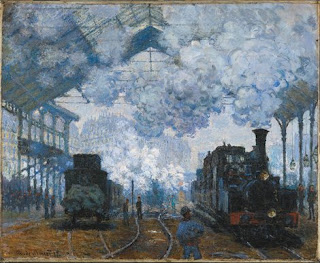
I am thinking, of course, about the coming of the railway—another technology
that changed everything.
That's the point made by academic, historian, essayist, philosopher and train-lover
Tony Judt, who died in August, 2010.
In an essay in the New York Review of Books titled "The Glory of
the Rails," he noted that "no competing form of transport, no subsequent
technological innovation, no other industry has wrought or facilitated change on
the scale that has been brought about by the invention and adoption of the
railway."
![]() |
| Claude Monet: Gare Saint-Lazare: Arrival of a Train, 1877. |
Before the arrival of railways, he wrote, travel between places like Paris to Rome had not changed for 2,000 years.
"Think of the limits placed on economic activity and human life chances by the impossibility of moving food, goods, and people in large numbers or at any speed in excess of ten miles per hour," he wrote, along with the "enduringly local nature of all knowledge, whether cultural, social, or political, and the consequences of such compartmentalization."
Until 1830, he said, "few people knew what unfamiliar landscapes, distant towns, or foreign lands looked like because they had no opportunity or reason to visit them."
After the arrival of the railway, their world
changed—for the very first time, many people could go places they had never been to before.
Trains, he said, represented a new and novel conquest of space.
"Canals and roads might be considerable technical achievements; but they had almost always been the extension, through physical effort or technical improvement, of an ancient or naturally occurring resource: a river, a valley, a path, or a pass," he wrote.
Railways, on the other hand, "reinvented the landscape. They cut through hills, they burrowed under roads and canals, they were carried across valleys, towns, estuaries."
![]() |
| The Opening of the Stockton & Darlington Railway, 1825, Terence Cuneo, 1949. |
This conquest of space also led to the reorganization of time.
"Even the modest speeds of early trains—between twenty and thirty-five
miles per hour—were beyond the wildest imaginings of all but a handful of
engineers," Judt said.
Trains were also dangerous.
"Signaling, communication, and braking
systems were always one step behind the steady increase in power and speed of
the engines: until well into the later 20th century trains were better at
moving than stopping," he added.
The need to keep trains from colliding—keeping them a safe distance from each other and off the same track—resulted in the creation of the timetable.
"It is hard today to convey the significance and implications of the timetable," Judt noted.
It was firstly a way to organize railway traffic, but it ended up
organizing daily life.
People needed to know the time so they would know when
the train arrived or left, and soon "everything that came after—the
establishment of nationally and internationally agreed time zones; factory time
clocks; the ubiquity of the wristwatch; time schedules for buses, ferries, and
planes, for radio and television programs; school timetables; and much
else—merely followed suit."
![]() |
| French Station, Guy Pène Du Bois |
Train travel also revolutionized society.
Until the opening of the
first railways in England, "people did not travel together in large groups,"
Judt said. "A typical stagecoach held four inside and ten outside. But it was
not much used, and certainly not by those with any choice.
"The wealthy and the
adventurous traveled alone or en famille—on horseback, in a post chaise or a
private carriage—and no one else traveled far or often.
"But rail travel was mass transit from the very outset—even the earliest trains conveyed hundreds of people."
There's much more in his essay which, unfortunately, is no longer available free online. But as we mark the 20th anniversary of the Web, we can celebrate that incredible innovation and also celebrate the railway—another world changing technology.
Thursday, March 7, 2013
Model Railroading as Art, or Art as Model Railroading?
Some think that model railroading is an art. Others think that art is model railroading. Kim Adams is in the latter camp.
Born in Edmonton in 1951, Adams is considered one of
Canada's leading contemporary artists. His installation art has been exhibited
throughout Canada and internationally since the late 1970s.
To make his art, he uses commonplace objects such as auto
parts, household objects, toys and, yes, model trains to create sculptures that,
according to the Art Gallery of Ontario (AGO), “resemble fictional worlds and
imaginary landscapes.”
Reading that, I had to think: That sounds like most model
railroaders I know.
Like Adams, we are forever finding ways to use ordinary
items on our layouts—mostly because we are cheap and want to save money.
Like Adams, we also strive to create fictional worlds and landscapes.
Like Adams, we also employ “a careful, laborious approach,”
as the AGO describes his artistic method.
Like Adams, some of us also populate our layouts “with
scores of people engaged in a dizzying variety of activities.”
Unlike Adams, however, nobody gives us awards and money for our “art.” For his
efforts, Adams was awarded the $50,000 Gershon Iskowitz Prize
from the AGO.
Also unlike Adams, we don’t use rolling stock like he
does—piling them on top of each other and filling hopper cars with dirt and
turning them into gardens. That’s what he did for Artist's Colony (Gardens),
currently on display at the AGO. (See photos this page.)
But I’m not complaining; my hat's off to Adams for doing what
he does and winning the big prize.
All I have to say is that if an art critic is reading this
blog post, feel free to send me a note. I’ll be happy to put my layout on
display.
If it helps, I might even glue some rolling stock on top of
each other.
For more information and photos of
Adams’s work, click here.![]() |
| A novel way to use hopper cars . . . . |
![]() |
| A new way to think of a "stack" train. |
Subscribe to:
Posts (Atom)


.jpg)
.jpg)
.jpg)


-2-660.jpg)
-4-660.jpg)
-8-660.jpg)