Tuesday, May 31, 2011

Death and the Model Railroader III: Remembering David R. Dyck

David R. Dyck on a CP Rail SD40-2 during a last
railfan trip together.


This week I am remembering my good friend, and fellow model railroader, David Dyck.

Dave died of cancer on May 29, 2004. Before he died, I helped him take down his layout. It was the only time I saw him shed a tear.

David taught history of science at the University of Winnipeg. His area of scholarly interest was the life and work of Sir John F. W. Herschel (1792–1871), recognized as one of the the most important figures in 19th century science.

Before David became to sick to travel, we took one last railfan excursion together in fall, 2003. We followed the CPR line to Moose Jaw, Sask. and then down through North Dakota. It is an experience I remember fondly.

Dave's tombstone, showing the things he loved and valued:
His faith, farming, science (sundial on the left)
trains and books.


Other posts in this "series" on death and the model railroader can be found here, here and here.

Saturday, May 28, 2011

The World is Flat(s)

 The Walthers Hardwood Furniture Co., rearranged.


The world, we know, is round. But when it comes to structures on the Manitoba and Minnesota Subdivision, it's made up of flats—flat structures, that is.

Of the 50 structures originally on the layout (before I reduced it in size), only 15 were modelled in three dimensions. The rest were flats, positioned against a wall or backdrop.

This great flat was built by my friend Rick Ritchie.
Can you spot the John Allen building?


Many of the flats were made from commercial structure kits. For some, I used only one wall. For others, I built them out lengthwise, gluing the sections to foam core to keep the sections together.

I don't remember who made this kit. (DPM?) The
warehouse on the right is scratchbuilt from styrene.


Some of the flats were also scratchbuilt, using Evergreen styrene glued to foam core. The largest one on the layout made like this is the Peace River Paper Mill.

The Peace River Paper Mill is over 10 feet long.


To blend everything together, I placed photos of buildings between the flats. In some cases, the photos are actually of real kits, taken from model railroad publications. In a few cases, they are photos of actual kits on layouts—once again, from model railroad publications. A structure from John Allen’s famed Gorre and Daphetid layout (in Port) even pokes itself out from behind one flat.

Flats and photos mingle to try to create a believable scene.
The store on the left is from the cover of a DPM box.


As I have written on this blog before, looking at photos of flats and backdrop buildings makes everything look, well, flat and unrealistic. It’s only when you are following a train that the flats blend into the total visual experience, suggesting that the work continues on past the wall or backdrop.

In the meantime, the flats are an excellent way to make buildings stretch further, without additional cost. As a bonus, you get something unique on your layout that likely won’t be seen on others.

A view down the yard, showing the mix of flats and photos.

Monday, May 23, 2011

Tracking Down the History of VIA Passenger Cars in Nashville, TN


I was in Nashville, TN just over a year ago. My hotel was near the former Nashville Union Station, now a (very nice) Wyndham Hotel.

Walking around the back, along the CSX main line, I came across the two forlorn VIA passenger cars pictured above. (Photo taken with my cell phone.) This isn't a place to find old Canadian passenger cars. How did they end up there?

Thanks to the Internet, I found out. The first car is former VIA 9479. Built by Pullman Standard in 1948 as NYC 10443, a 22 roomette sleeper named Thunder Bay, it was sold to CN in 1958 and was renamed CN 2067 Valparaiso.

In 1973 it was converted to a baggage-dormitory car with 14 roomettes and renumbered CN 9479. It was transferred to VIA in March 1978 and placed in storage in 1992. See a much better photo below, taken by Doug Wolfe and found on Railroad Picture Archives.


The second car is VIA 2149 Clearwater River. It was built by Pullman Standard in 1949 as Erie 10&6 sleeper Benjamin Loder. It was sold to CN in 1958 and numbered 2149. In 1978 it was transferred to VIA and placed in storage in 1990.

The car is believed to be the sole survivor of the seven cars (Benjamin Loder, Charles Minot, Daniel Craig McCallum, Eleazar Lord, James Gore King, Marvin Kent and William Reynolds) built by Pullman Standard, to plan 4129A in lot 6797, for the Erie in 1949.

See another better photo, this one by John Owens, also from Railroad Picture Archives.  


The two cars, now numbered SLCX (St. Lawrence Cement) 2149 and 9479, belong to a development company in Nashville that uses the name “Gateway to Nashville, LLC.” Apparently, they were going to be fixed up for re-use, but that clearly hasn’t happened yet.

The tracks they are on are not connected to the nearby CSX line; behind them, and underneath the bridge (as seen in the second photo), there are other VIA passenger cars in various stages of reconstruction at Cummins Station. Anyone know anything about them?

(Thanks to Bryce Lee, former editor of Canada Calling, for the info on the cars.)

Saturday, May 21, 2011

Most Unusual Layout Location?

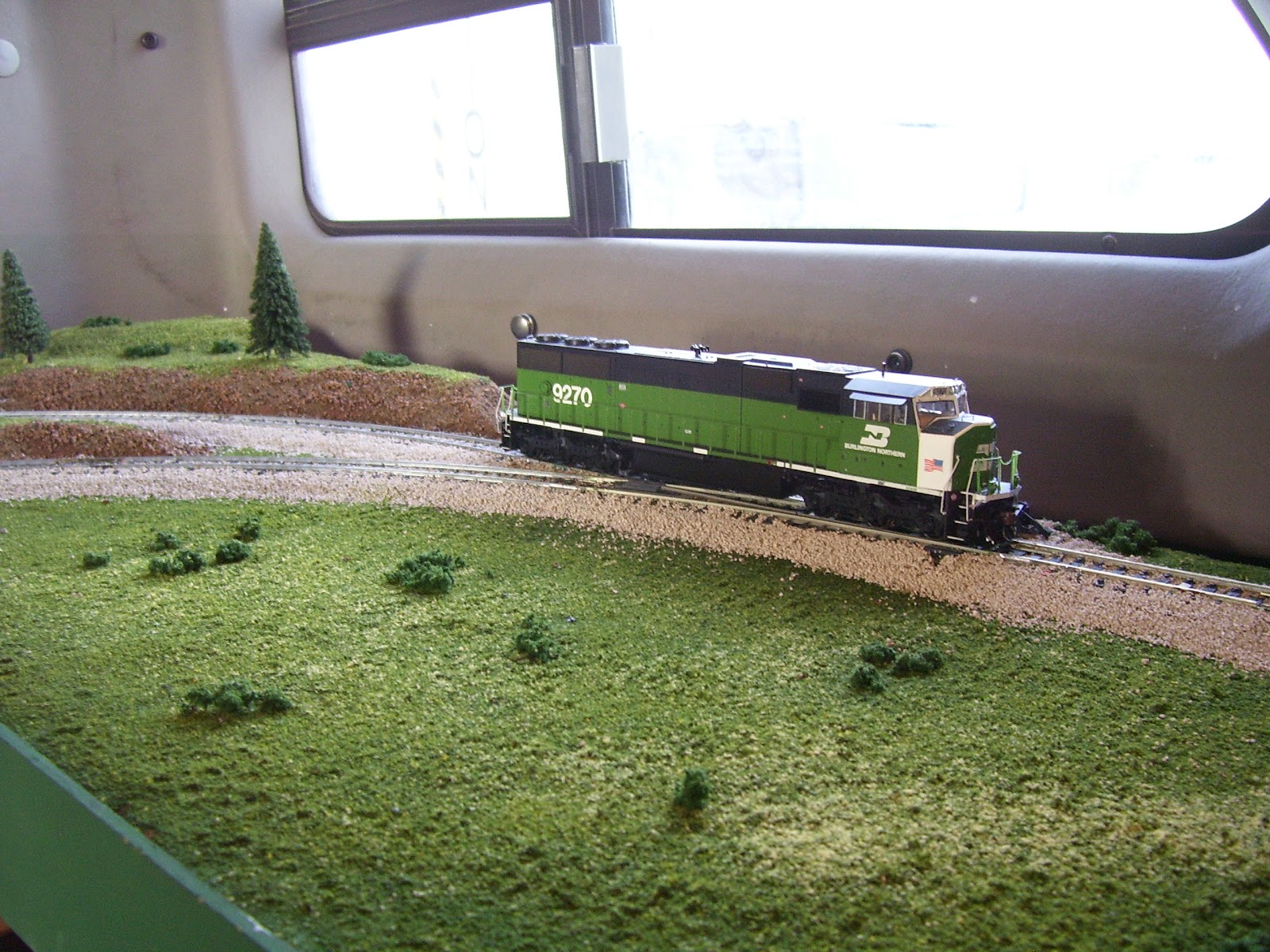
Most unusual place for a layout?


What do you do if you are a long distance trucker and a model railroader? Build a layout in your truck, of course!

At least, that's what my friend Ian did. Being on the road a lot means it's hard for him to find time to build a home layout. No problem; Ian decided to build a layout he can take with him wherever he travels.

Right side of the layout.


The 5 by 7 HO scale layout is built on the top bunk in the truck's cab; Ian sleeps on the lower bunk. Three of the four sides of the layout sit on brackets attached to the upper bunk. The front section is removable for driving. When he gets to a rest stop, and wants to run trains, Ian attaches it to the layout with clamps and he's ready to go.

It's an unusual, or at least an unexpected, place for a layout. But for a dedicated model railroader like Ian, it's a chance to relax after a long day of driving by running trains.

Looking at what he has constructed, I think he's also given a whole new meaning to the idea of a portable layout!

Left side of layout.


Nice scenery!

Thursday, May 19, 2011

Around the Engine Yard

The engine yard on the M & M Sub. is just a shadow of its former self. (See Vestiges of the Past On The M & M Sub.) But it's still an interesting place, what with it's filled-in former turntable pit, a few yard and road engines, and few interesting structures.


GP38-2 3021 pokes its nose out of the Pikestuff engine shed.


An old boxcar serves as a materials storage facilty.


The top half of an old Athearn tank car does new duty as a fuel tank.


Another view of the engine yard, showing the filled-in turntable pit.