Sunday, March 31, 2013

End of the Line for The Model Railway Show


After two and half years and 52 episodes, The Model Railway Show—and Internet podcast about the hobby—has reached the end of the line.

In a statement, producers Jim, Trevor, Chris, Otto and David say they have decided it’s “time to get back to our work benches.”

The podcast, they go on to say, “was a volunteer effort—a labour of love—and while we enjoyed interviewing so many great guests and creating these shows, it has demanded a fair bit of hobby time.”

Although they will not be producing any new episodes, the archive of old episodes will continue to be available on the Web.

So, farewell to The Model Railway Show, and thanks for creating something of benefit for many modellers. 

Read my interview with Jim and Trevor here.

Saturday, March 30, 2013

More Operational Interest with the Hospital Train

The hospital train pulls into the yard.


Earlier this month, I wrote about adding a hospital train to the Manitoba & Minnesota Sub.--a train made up of locomotives and rolling stock headed for repair, to museums or to the scrapper.

At first, the train just made a regular appearance on the layout, passing through from east to west. Then I realized I could do more with it--give it more operational value.

It drops off the items for the museum.


As I wrote about earlier, I added a railway museum to the town of Turney on the upper level. The former freight house is home to a collection of railway ephemera, including an old caboose, and SD40-2 (in classic maroon and grey), a 40-foot boxcar and an old passenger car. (A different assortment than that featured in the original post.)

When I made up the hospital train, I took those items from the museum and added them to the train. They looked good running across the layout. But then I thought: Why not have them yarded in Fort Frances and then brought up to Turney by a special movement? And that's what I did.

A special movement takes them west.


Now when the hospital train makes its appearance, we can go back in time like Bill Murray in Groundhog Day,, repeating that day when the various railway items were brought to the museum over and over again.

Almost there . . . .


Yarding the items bound for the museum adds another operational event to the layout--although I have no way of replicating the "big hook" moving the cars and locomotive from the siding to the museum trackage. That's what hands are for!

In the siding awaiting the crane to
move them to the museum track.


Thursday, March 28, 2013

Who Says A Loop of Track is Unprototypical?


Artist's rendering of the new facility.


One of the axioms of model railroading is that a loop of track a 4 x 8 sheet of plywood is unprototypical, not to mention boring.

Nobody told that to the Dakota Plains Holding Inc., which is planning a double-track loop for its new oil loading facility in New Town, North Dakota.

To keep up with booming shipments of crude oil, the company is building a $50 million expansion of its crude oil loading facility in the northeastern part of the state. It will be able to rapidly load trains of up to 120 tank cars.

As reported in the Minneapolis Star-Tribune, the project will add looped tracks for easier loading, boosting daily throughput capacity from 30,000 barrels to 80,000 barrels.

The project, which is served by the CPR, will be completed by the end of the year.

BTW, North Dakota--once famed for being home to over 1,000 nuclear missiles pointed at the former Soviet  Union--is now the second-largest oil-producing state behind Texas. Since it doesn't have many pipelines, 68 percent of the crude oil production in the state is shipped by rail.

Saturday, March 23, 2013

A Model Railroad Bucket List

New England, Berkshire & Western.


A couple of weeks ago, I posted an article about the closing of the Toronto Model Railroad Club. In it, I expressed my regret at never having seen it in person.
That made me think of other layouts I have missed seeing--and of those I want to see. It prompted me to think of making a model railroad bucket list of famed publicly accessible layouts to see before I die.

The Great Train Story.


I thought it would be interesting to get a little help in this quest, so I posed that question on several model railroad forums. What well-known public layouts (not home layouts) would people like to see before they, you know, kick the bucket?
I got a number of answers, including one that made me smile: "I'd like to see my own layout be completed before I die." I think a lot of us would share that sentiment!


So here, in no particular order, are the public layouts other model railroaders say they would like to see before they die. 

Curiously, nobody mentioned the Milwaukee, Racine & Troy, the layout owned by Model Railroader magazine. I wonder why that is--is it because we've seen so much of it in the magazine? (That is one famous layout I actually have seen!)
Minatur Wunderland. (Hamburg, Germany.)

Nortlandz. (Flemington, New Jersey)

New England, Berkshire & Western (Renssellaer Polytechnic Institute club, Troy, New York.)
 
Greeley Freight Station Museum. 
(Greeley, Colorado)

The Great Train Story at the Chicago Museum of Science and Industry.

San Diego Model Railroad Museum. (In San Diego, of course.)

Franklin & South Manchester. (George Sellios' private layout in Peabody, Mass., but one he apparently opens for public viewing).

Puget Sound Model Railroad Engineers in Tacoma, Washington.

Some of those are on my bucket list; I also hope to make it to the Doubleheaders layout tour in Kitchener/Waterloo, some day.

What would be on your list?

Puget Sound Model Railroad club.


Thursday, March 21, 2013

Al Capone, Prohibition and the Thunder Creek Model Railroad Club


What do Al Capone and the Thunder Creek Model Railroad Club have in common? 

No, not trains (although Capone did ride on one to Alcatraz--the so-called "Forty Thieves Special.") What they have in common is the city of Moose Jaw, Saskatchewan.

Or, at least, the Thunder Creek club does; Capone's connection is a little iffy. It goes back to prohibition in the U.S., when Moose Jaw was a jumping off point for alcohol headed to Chicago. 

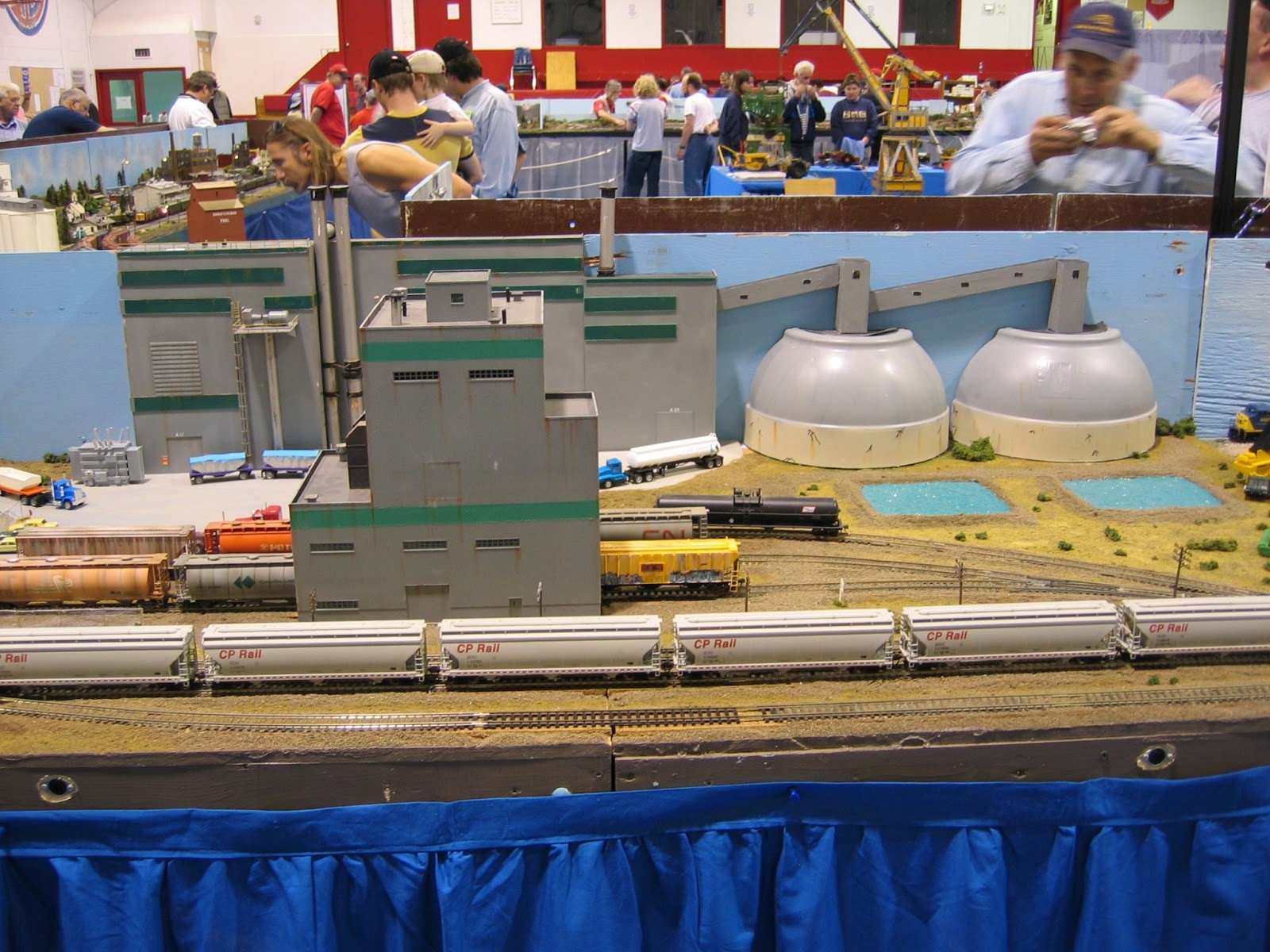
Thunder Creek layout at the 2004 Winnipeg Model
Railroad club Show, with the iconic Calgary
Tower in the foreground.


Beneath Moose Jaw's streets are an extensive network of tunnels, originally built to connect various buildings. During prohibition, they were used to hide copious amounts of alcohol prior to transport south.

According to several reports, Capone actually visited the city, although no photographic record or documentation exists.

As for the Thunder Creek club, there are plenty of photos proving its existence. And if you want to see it in person, you can do that March 23-24 at the club's 8th annual show at the Western Development Museum, where you can also see some real trains on display--and the 1949 Fudge Snowplane, a local Saskatchewan invention (see photo below). 


If you can't get to the show, you can visit the club's website, or just enjoy the photos of their fine modelling on this page (including their model of the iconic Calgary Tower--the kind of thing you aren't likely to find on many layouts.). Photos taken at the 2004 Winnipeg Model Railroad Club fall show.


For more about Capone and the tunnels of Moose Jaw, click here.