Showing posts sorted by date for query Ken Epp. Sort by relevance Show all posts

Wednesday, April 22, 2020

Winnipeg Pandemic Virtual Layout Hop


In spring, the Winnipeg Model Railroad Club sometimes has a layout hop—visiting local layouts. Since we can do that during the pandemic, how about a virtual hop? I’ve assembled a list of links to Winnipeg layouts featured on my blog.

The good thing about a virtual layout hop is no driving between layouts, or trying to choose which ones to see based on time available. And best of all, even though many of these layouts no longer exist they can still be visited this way. Enjoy!

First up is Arnold Walker’s HO scale Northland Route, which was one of the premiere layouts in the city. And because there is so much to see on Arnold’s layout, you may need more time. So take a second look at the Northland Route.


Next is Stafford Swain’s HO scale CN Whiteshell Subdivision, including tributes to Stafford. (Who passed away in  2018.)

After that, let’s head over to George Meyer’s O Scale Central Northern Subdivision. George was in N and HO scales before settling on O scale and making this fabulous layout. He passed away in 2019.

Back to HO scale with The Carson and Cobourg,  a layout build by two friends—Marvin Fetch and Vern Gibson.


No visit to layouts in Winnipeg is complete without going to fall in Pennsylvania! That’s the theme of Ron Loewen’s O scale layout, built in a room above his garage.

The Miller Creek Forestry Museum layout started life in B.C., but now makes its home in Winnipeg. Take a look at this amazing ON30 layout!

Wonder what a layout built on four levels looks like? One that goes all around a basement, including through a bedroom and rec room? Then you have to stop by Ken Epp’s Cougar River Subdivision! Ken passed away in 2014.


If four levels isn’t enough, what about five? You can’t miss Ray Goy’s Twin Lakes Terminal & Transfer Railroad, a monster layout on five levels that completely (and I mean completely) filled Ray’s 1,250 square foot basement.


Since it’s spring, maybe the Assiniboine Valley Railway is in operation! Nothing like a ride on Bill Taylor’s 7.5 inch AVR—the route of the hazelnuts.


For a treat, visit one of the oldest home layouts in the city: Don McKinnon’s Malamute & Klondike. It was in the same house for 63 years in the same house until Don passed away in 2013. (Must be some kind of record.)

And I suppose not layout hop in Winnipeg would be complete without a visit to my own layout, the Manitoba & Minnesota Sub., or my N scale Thompson River Canyon hollow core door layout.

Thanks for coming on the hop! Hope you had a good time.


Friday, September 1, 2017

Tony Koester, Multi-Deck Layouts and Me


So I was re-reading a copy of Tony Koester's book Desiging and Building Multi-Deck Model Railraods, when I came across a couple of paragraphs about me.

Well, not about me exactly, but about the Manitoba & Minnesota Sub., and how it (and my late brother-in-law's layout) influenced Tony to build his own multi-deck layout.

Tony was a guest presenter at 2000 during the NMRA Thousand Lakes Region Millennium Express convention in Winnipeg.

During the convention, he visited local layouts—including mine and the Cougar River Subdivision, owned by my brother-in-law Ken Epp.

I don’t remember much of what Tony said during the visit, but I remember he paid me a compliment on my modeling. It meant a lot to me.

What I didn’t realize, until I re-read the book recently, was that his visit also caused him to take a dramatic turn in his own modelling.

In the introduction to the book, Tony wrote that for a long time, he couldn’t see himself “adopting the multi-deck approach to layout design any time soon.”

Then, in 2000, he came to Winnipeg, and got “quite a surprise.”

“During an extensive layout tour, I discovered that every new or newly revised model railroad on the tour had multiple decks! 

"One huge basement layout had at least three decks, in fact, with the upper one above eye level . . . something was clearly in the wind.”

Four levels on Ken Epp's Cougar River Sub.


“The story of what was in the wind is what this book is all about.”

“It’s as much a fascinating story of the recent history of progressive model railroad design as it is a how-to book.”

Three levels on the M & M Sub.


After reading those lines, I wrote Tony about his comments.

“That visit to Canada was indeed an eye-opener,” he replied, adding that Canadians seemed to be starting a trend.

Two levels on the M & M Sub.


As for the book itself, there’s a photo of the M & M Sub. in it. There is also a photo from the layout in another of Tony’s books, Model Railroading from the Prototype to Layout.

One of these days, I want to see Tony’s Third Subdivision of the Nickel Plate Road multi-deck layout, and see him once again in person.

Meantime, I can reflect on my tiny contribution to that great model railroad.

Tony's NPR layout.


.

Saturday, August 26, 2017

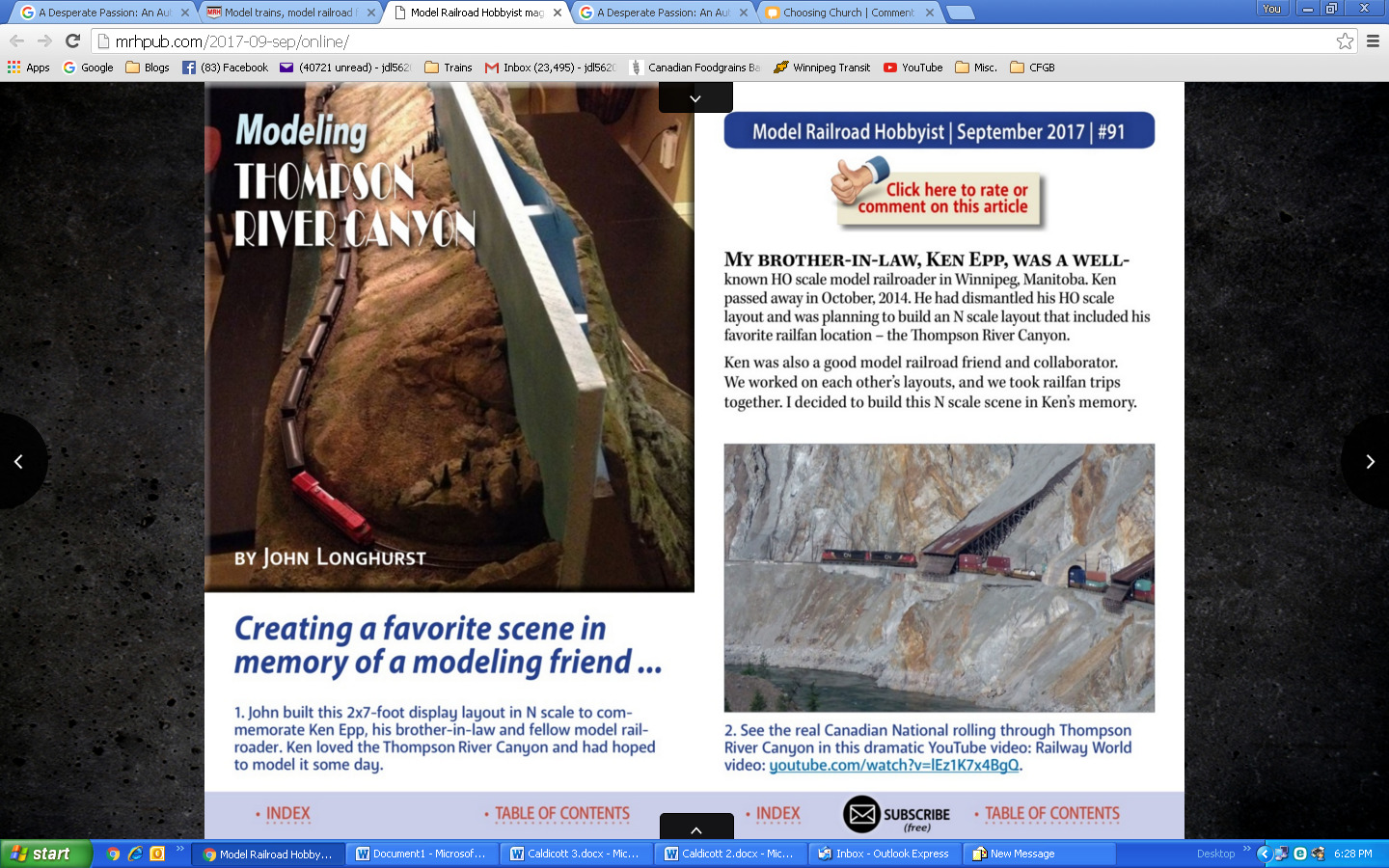
Thompson River Canyon in Model Railroad Hobbyist


In August it was the HO scale M & M Sub. on the cover of Canadian Railway Modeller. Now my Thompson River Canyon N scale layout is in the September issue of Model Railroad Hobbyist.

Getting in a magazine is always special, but this is a special honour since the layout was created in memory of my brother-in-law Ken Epp, who died of cancer in 2014.

Before he died, he was planning to build an N scale layout based on his favorite railfan area, the Thompson River Canyon in B.C.

Since he died before he could do that, I decided to build it for him. In this case, it was a simple loop on a 2 x 7 hollow core door.

While many have seen the layout on this blog, it’s great to be able to share it, and my memory of Ken, with many others through MRH.

(It’s also pretty cool to be in an issue that features the modelling of Bob Rivard, who is someone I greatly admire in the world of model railroading.)

You can read the whole issue, and read the article, here. 

Wednesday, August 31, 2016

Thompson River Canyon N Scale Layout: Done!


And so it is done—the Thompson River canyon memorial layout is finished.

It took a year to finish both sides. I thought I would get it done quicker but, you know—life.

Actually, I’m sort of sorry it is finished now. Unfinished, it gave me comfort—it was always there, waiting for me to do some work on it.

But with it now done, and my HO layout long done (after tearing down a third of it and starting over), I don’t have any new model railroad projects. I feel undone, to be honest.


But it was a fun project while it lasted. And meaningful, as through the construction I recalled my brother-in-law Ken Epp, who died in 2014.

As I noted in earlier posts about this project, after building a great four-level HO scale layout (the Cougar River Sub.) Ken had downsized and moved to a condo. 

His next goal was to build an N scale version of his favourite railfanning area: The Thompson River canyon.

Unfortunately, cancer took him at age 59 before he could complete that dream. Instead, I received the N scale stuff he had accumulated from his family and built it for him, and in his memory.


It’s not big—just a 2 by 7 on a hollow core door. But I hope it catches the spirit of the canyon that he loved. (And where his ashes are scattered—by the railway tracks—at his request.)

One side of the small layout features the steep, rugged part of the canyon where snow and rock sheds are needed to protect the trains.

The steeper side.


The other side features the less steep and more arid part of the canyon.

The more arid side, with my HO scale
layout in the background.


As I noted in my earlier posts about the most recently-completed part of the layout, I mixed grey, various shades of brown, tan, black and white craft paints to achieve the colourations.

The trick to this kind of believable scenery (as on the other side), is to vary the colours, making sure to blend them together near the edges.

Everything on the layout is extruded Styrofoam or cardstock (for the tunnel portals and rock sheds). This includes the boulders, which are cut to shape.

What it looked like earlier.


To cover holes and cracks, I glued pieces of foliage between the boulders and places where it was too hard to paint near the backdrop (which is just a one-inch piece of Styrofoam spray painted blue). I was careful not to use too much, since this is a dry area.

The ballast is my own special blend of grey, cinders and buff. This prevents it from looking too uniform. I also painted the track brown.


The water is a mix of deep river green and black green—the lighter colour indicating where the river is shallower near the edge. I used matt medium to make it glossy.

And that’s it—a simple but, I hope, convincing representation of an area that was close to Ken’s heart. The completed layout will be formally unveiled at the Sept. 24-25 Manitoba Mega Train show.

For some, it may be too simple: Just a train going around in a loop. But I actually find it very relaxing, sort of like watching fish in an aquarium. 

And it was a lot of fun to build. R.I. P., Ken Epp.

Click here to see all the posts about building this layout, including two videos.


Thursday, July 28, 2016

Death and the Model Railroader: Ashes to Ashes


Before he died in 2014, my brother-in-law, Ken Epp, asked his family to scatter his ashes in his favorite place: The Thompson River Canyon in B.C., near the railway tracks.

His wife and kids are doing that this week. Before they left for B.C., they asked if anyone would want some of Ken’s ashes for a memorial.

I asked for a small amount, which I placed inside a sealed bag in a boxcar. Not just any boxcar, but one I bought at the last train show we attended together (just a few weeks before he died).

After placing the ashes in the car, I gave it a trip around the layout. 


Before, whenever I saw that car on the layout, it reminded me of him. Now it carries more than just a memory; it literally carries a bit of him as well.

Some might find it ghoulish, but for me it’s a way to remember Ken. Not only that—and I know this would make him smile—it’s a way he can “ride” trains on my layout!

(I am also making a small N scale layout in honour of Ken, inspired by the Thompson River Canyon area. Click here to see it.)

Tuesday, September 29, 2015

Tibetan Prayer Wheels and Model Railroading, and a Life in Boxes


A couple of random thoughts following last weekend's Manitoba Mega Train show . . . .

A Life in Boxes

Next to me at the show was my friend Marvin Fetch. He was selling another estate, this time that of long-time local model railroader Bill Morrison.

Bill, who died last April, amassed an enormous collection of model railroad items--over 200 passenger cars and over 1,000 freight cars, along with many locomotives. 

There were so many boxes at the sale that Marvin couldn't put everything out all at once; he was constantly going behind or underneath the tables looking for things.

Not to get too philosophical or anything, but as I watched Bill's cherished collection being sold, I had to think: This is how it often ends. 

During our lives we accumulate locomotives, cars and other things for our layouts then, one day, when we die, it's all in boxes at a train show.

Bill's widow, Anne, was fortunate to have someone like Marv to come along to help her sell his trains. It was a huge task, going through his stuff; not everyone is so lucky.

As for me, I have created a list of all my trains, with suggested prices, and have asked a friend to sell them for me should I pass away before I can do it myself. It's the least I can do for my family, to make things easier for them.
 
Oh, and if that happens, I could be like my friend Harold Weston, who left a parting gift for those who had the sad task of tearing down his layout after his death. 

When they took down the mountain scene that dominated his O scale pike, they found a hidden bottle of fine whiskey with a note. 

The note said that if someone was reading it, that meant Harold was dead, and thanks for helping to take down the layout--and please have a toast for and on him. 
 
Tibetan Prayer Wheels and Model Railroads
 
As I have written on this blog, I built the N scale Thompson River Canyon layout in memory of my brother-in-law, Ken Epp. I unveiled the layout at last weekend's show.
 
As I watched the train go around and around (and around and around again), I felt a sense of peace. There was almost a spiritual quality to it, a settling of the soul as I watched the train pass by. It almost made me wonder if it could be a meditative practice.
 
And that made me think of Tibetan Buddhist prayer wheels. Adherents of this religion place a prayer inside these hand-held instruments, which have a weight attached with a chain. They then twirl them around. Each time the wheel turns, the prayer inside is believed to be prayed.
 
Since the layout was in memory of my brother-in-law, I got to wondering if it couldn't also be seen as a form or prayer (especially if I was a Tibetan Buddhist).
 
By my calculations, the train went around the loop of track over 1,900 times in the two days. If it was a model railroad prayer wheel, that would be a lot of prayers for Ken!
 
(Speaking of Tibetan Buddhism, check out my post about how a model railroad is like a Tibetan sand mandala.)

Anyway, those were some of the thoughts that came to me at the train show, and as I watched the train go around and around, and as I watched Bill's lifetime of collecting be sold piece by piece.

Saturday, September 26, 2015

Thompson River Canyon: On Display for the First Time at the Manitoba Mega Train Show


The layout was a hit with the kids.


It was a successful first day at the Manitoba Mega Train Show, where I unveiled the Thompson River Canyon portable layout.

Even though the weather was great, attendance was good--even higher than the first day last year.

The layout on display.


It was good to talk to friends about my brother-in-law, Ken Epp, and remember him and his interest in the hobby.

It was also good to watch the kids watch the train go round-and-round. I discovered (again) that kids really like tunnels; they would watch it disappear and appear again and again and again.


There was even some visiting power on the layout, courtesy of an N scale friend at the show.

The show runs again tomorrow, after which I will take a break from working on it. My goal is to complete the other side in time for the April, 2016 Winnipeg Model Railroad Club annual spring show.

Speaking of which, I realize I haven't posted a photo of what the other (unfinished) side of the layout looks like; find it below. The finished side looked like this just six weeks ago.

To view all the posts in this series, click here: Thompson River Canyon.

The unfinished side.


The finished side.


The reason for making it.

Thursday, September 24, 2015

N scale Thompson River Canyon 6: Conclusion


Now for the fun part—painting the scenery!

But first, this note: Many modellers who use extruded Styrofoam for scenery cover it with plaster cloth or some kind of goop before proceeding to the final step.

I have never understood why they do that; painting directly on to the Styrofoam has always worked just fine for me.

Besides, with a portable layout like this, the goal was to keep it light—not add extra weight from plaster cloth or goop.

Choosing the Paint

Like I did with my HO layout, before starting to paint I checked out the mistake section of my local home renovation store. Sometimes you win, and sometimes you lose—I won this time. here was a litre of mis-tinted grey/beige paint for sale for a fraction of the regular price. I used this as a base paint.


I also bought some cheap acrylic paint at the dollar store: White, black, burnt umber, and brown.

Painting the Canyon Wall

My goal was to create a canyon that was mostly beige/grey, but not uniform in colour. Depending on what time of day a photo of the canyon was taken, or in exactly what area, the colours can vary—some photos make it look very light grey, others are more multi-hued. I decided to go for the latter.


Top view, showing what it looks like to have a
one-foot high canyon wall in N scale.


I started by putting on some of the base paint, then squirted on white, brown or black to add colour. 

My first attempts were too dark, so I went back and lightened them up. Fortunately, this kind of painting is very forgiving. Don’t like it? Do it again?

When the paint was wet, I sprinkled on a bit of green ground foam. At first, I added too much—there is very little vegetation in this part of the canyon. When it was dry I scraped some of it off. There may still be too much, though.

When the paint was dry, I dry-brushed on some white and light grey to highlight features in the canyon wall. I also added other highlights where I thought it could be helpful.


The view looking up.


At the left end, I added a number of Styrofoam “rocks” and “boulders.” (Those pieces I saved when shaping the wall.) I made this area mostly grey for contrast.

Overall, I think the effect is good, even if not exactly like the prototype. Best part is that if I want to change it, I can just start over again!


Painting and Ballasting the Track

After the canyon walls were painted, I painted the track. For me, this is possibly one of the more critical things any modeler can do to try to achieve some semblance of plausibility on a layout.

In my mind, nothing says “toy” louder than unpainted track. Visitors may not know much about scenery, trains or structures, but everyone knows that track isn’t silver.

I painted the track with a mixture of black and brown. Only one side is painted, since that is all you can see.


After the paint on the track was dry, I added ballast.

I used a mixture of grey, black (cinders) and brown for my ballast. I find that using a mix prevents the ballast from looking to uniform and tidy. In this case, I mixed three parts grey with one part black and one-half part brown.

I affixed the ballast with my usual method of “wet” water and diluted white glue.

After the track was painted and ballasted, I glued the sheds to the layout.

Painting the Water

For the river, I used a mix of Ceramcoat black green and deep river green. These paints are a bit more expensive, and available only at a craft store, but worth it to achieve the look of a realistic river.


I painted deep river green, which is lighter, along the shore, to suggest that it isn’t as deep, then painted black green out to the edges of the layout.

When done, I put on a coat of gloss medium to make the river look wet and shiny.

Again, depending on the time of day, and whether it is overcast or sunny, the colour of the river can vary. This seemed like a good choice for me. Plus, I already had those paints on hand from my HO layout!

Next . . . 

Next up, I will finish the other side of the layout. This will represent a part of the canyon where the walls are less steep and the ground more beige and sand colour. That will be my winter project.


Overview of the layout.


And there you have it: The Thompson River Canyon in N scale. It took me just over a month to build the layout and complete this scene. It's nothing special, and not especially elaborate. But I think it conveys the impression of the prototype that I am trying to make.

And it helps me to remember and honour my brother-in-law, Ken Epp—which I will do this weekend when the layout is unveiled at the annual Mega Train Show here in Winnipeg.

My brother-in-law, Ken Epp, at last years Mega Train
Show, a few weeks before he died.


Read the previous post about making the canyon walls.

To view all the posts in this series, click here: Thompson River Canyon.