Tuesday, November 1, 2016

Newton, Kansas: A Great Little Railroad Town


If you like trains, and lots of mainline action with some shortline activity added—then Newton, Kansas is a great place to visit.

Newton, with a population of just over 19,000, is located about 40 kilometres north of Wichita. It is on the BNSF (former Santa Fe) mainline between Chicago and Los Angeles.


Railroads and Newton have been linked for a long time. In 1872 it became the western terminal for the Atchison, Topeka and Santa Fe Railway and the railhead for the Chisholm Trail.

Business takes me to Newton about once a year. I was there again in October, and had two occasions to wander trackside.


Train watching is easy in Newton. The locomotive facility is easily seen from nearby streets, although you need a zoom lens to get decent photos.

The mainline crosses Main St. right by the locomotive facility and the Amtrak Station (with its classic ATSF Harvey House design), providing close-up views of the action.


Train activity is frequent—a delight for the visiting railfan, but a source of much grumbling among the locals who have to wait often at crossings for the trains to pass.

In two brief trips trackside I caught four mainline freights and a locomotive move. 

Unfortunately, it was afternoon and all the trains were eastbound, meaning I was shooting into the setting sun.


I also caught a WAMX (Webb Asset Management) train pulling a long string of cars slowly across Main St. I think it is the Kansas and Oklahoma Railroad, but I’m not sure.

A wander around the streets alongside the locomotive facility showed a variety of power on site—units from KCS, CP, CN, CSX and NS were all present, along with a few units still in classic BN green, and even some in the old ATSF scheme.


Unlike in 2009, I didn’t see any trains with flatcars carrying Boeing 737 fuselages. Back then, I was lucky enough to catch a number of them waiting across from the station.


There are lots of little towns like Newton across North America, places where there is lots of railway action and relatively easy access to see the trains. Maybe you have a special place like it of your own.




Sunday, October 23, 2016

Not Again! The Canada Central Railway Forced to Move


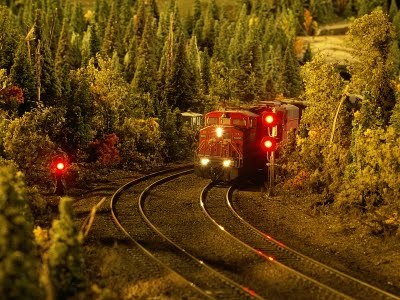
Four years after having to move to a new location, the Association of Railway Modellers of Montreal—owners of the Canada Central Railway—has to move again.

Founded in 1950, the club was in its former location, a CN warehouse, for 38 years.


After being required to move from that location, the club found a new home and started over.

But now they have to move again; I’m told the building will be turned into a parking garage.


This is beyond sad for the club and its members; the layout, which is under construction, looks great.

And yet it’s a story often told—renting space for a layout puts a club at the whim of a landlord.


Two other signature layouts in Canada found this out the hard way recently; the Model Railroad Club of Toronto had to vacate its old premises after 66 years in the same location, as did the Aberfoyle Junction, which had to leave after 30 years.

Both the Toronto and Aberfoyle clubs found new space; let’s hope the same thing doesn’t happen to them that happened to the Canada Central.


Meantime, here are a few photos of the progress on the Canada Central, courtesy of  Tony Synett. More of Tony's photos of the club can be found here. 


Saturday, October 22, 2016

SD40-2s on the CPR: Almost Gone, But Not Forgotten


As readers of this blog know, I like the SD40-2.

That’s one reason why the M & M Sub. is set in the early 1990s. That’s when the venerable locomotive, which was produced by EMD from 1972-89, was in plentiful supply on CP Rail.

At one time, CP Rail had 486 of the units (compared to just 123 on CN).

You won’t find much in the way of newer power on the layout. The most current units are two AC4400s, which had just begun to arrive on the railway in 1995.

Time on the layout is frozen, in other words.


But time in the real world marches on. 

And, as it does, there are fewer and fewer SD40-2 units in operation on what is now called the CPR.

Currently, there are only eight active SD40-2 locomotives in service on the CPR.

There are 192 SD40-2s still on the roster, along with seven SD40-2Fs (Red Barns). 

All except 11 are tied-up unserviceable (the eight active units, plus three others stored serviceable).

Soon there will be no SD40-2s on the CPR roster. Like the steam locomotives of old, they will just be a memory.

At least they can still keep rolling on the M & M Sub.

Thanks to David Stowe of Railfan & Railroad for the update.

Saturday, October 15, 2016

Another Fine Visit to the Prairie Dog Central (and Virginia Central RR 4-6-2 update)


In August I paid another visit to the Prairie Dog Central, Winnipeg's great tourist railway and preservation society. 

The Prairie Dog Central (PDC) is owned by the Vintage Locomotive Society. The Society runs regular passenger excursions that are often led by #3, a 4-4-0  steam locomotive built in 1882.


It might be the oldest operating steam locomotive in North America.

It was a great day to wander around the grounds, taking photos of #3 and other trains on display.


This included the two ex-CPR 4-6-2 locomotives formerly owned by the Virginia Central Railroad.


The two units were sold to an anonymous Albertan, who planned to start a new excursion service.

They came to the PDC in Winnipeg last year for storage to await the development of those plans.


But word is that those plans have fallen through, and the locomotives are once again up for sale. I wonder if one or both of them might end up staying in Winnipeg?


In addition to offering passenger excursions, the PDC is a real railway with real railway services though its Prairie Rail Solutions arm.

Those services include railcar storage, transload, cleaning and light maintenance, stenciling and switching, among other things.


The PDC is also home to the Winnipeg N-Trak club, which is housed in a building beside the tracks.

All-in-all, it's a great place to hang out on a fine summer day.

Click here to read about a previous visit to the PDC.


Monday, October 10, 2016

Update on the Kicking Horse Pass Layout


A couple people have asked for updates on the great HO scale Kicking Horse Pass layout (featured on this blog in 2010; see the post below.)

I tried contacting owner Jered Hoskins, but was unsuccessful. Fortunately, his friend Adam Meeks, who also worked on the layout, replied to queries about what has happened to it. 

As Adam reports, the layout was dismantled when Jered's business moved to a new location. As for Jered himself, Adam reports that he isn't very active in model railroading at this time; there are currently no plans to bring the layout back out on tour.

As for online information about the layout, Adam notes that this is the only place to read about it, other than an article in a 2005 issue of Canadian Railway Modeller (Train 13, Track 6).

As for the future, Adam says he isn’t sure what the future holds; there was some talk of selling it a while back, but for the time being Jered has chosen to hang on to it.

Meanwhile, enjoy this trip back in time . . . .

One of the best layouts I have ever seen is currently stored in a trailer in Calgary.

Called the Kicking Horse Pass, the portable layout was the brainchild of Jered Hoskins, who created it with several friends.

The 24 by 42 foot HO scale layout features big, modern power, long trains, and the same jaw-dropping scenery of the prototype, including the world-famous Spiral Tunnels.


The layout premiered in November, 2002 at Calgary's annual Supertrain show; in 2005 it was part of Golden Rails in Winnipeg, a convention celebrating the 50th anniversary of the Winnipeg Model Railroad Club.

As Associate Editor of Canadian Railway Modeller, I was also able to work with Jered on an article about the layout that appeared in the magazine that year.


In addition to the Spiral Tunnels, the layout features a 12-foot high mountain, working signals, CTC dispatching, over 700 feet of track, real water in the river, a two foot-elevation gain, sound, and a double-tracked helix to enabled trains to complete the circuit behind the scenes.

Train length ranges anywhere between 25 and 50 feet, and the longer trains can be surprisingly heavy—some even require mid-train power.


Putting all this in a basement would be challenging enough, but making the layout moveable was an added challenge—it pushed the limits of modular layout construction.


Weight was a concern, of course, yet the layout needed to be durable. This was resolved by constructing each module out of Styrofoam encased with acrylic stucco—the stucco provided a textured, neutral base for the scenery, and dried to the hardness of concrete.


The modules sit on wooden frames that are secured with carriage bolts to help lock them in place.

Perfect alignment is critical; for example, the module containing the upper spiral tunnel requires smooth track joints in three different places, at three different angles and on three different levels.

It takes a minimum of eight hours for three people to assemble, level, and prepare the layout for operation.

Whether operating or just watching trains roll by, the Kicking Horse Pass layout offers an experience unlike any other.