Sunday, October 9, 2016

Last Look at the Thompson River Canyon


Now that the Thompson River Canyon layout is done, and the Manitoba Mega Train Show where it was on display for the final time is over, this is a good chance to take a look back at the layout.

After bringing it home from the show, and before I sold it to a friend, I took it outside on the deck for some photos in the sunlight. The results are on this page.


As for thoughts about the making of the layout itself, it was a great project and a great way to remember my brother-in-law.

Finishing it not only meant the end of construction, but also saying a final goodbye to Ken: Letting him go, almost two years after his death from cancer.


I also enjoyed this foray into N Scale, over 40 years since I last was involved with that scale. Back then, locomotives had two speeds: Stop and fast. Today, they can crawl so slowly and realistically. And there is a great and wide variety of rolling stock.


N Scale also has a great scenery-to-trains ratio, something I tried to use for good effect on the Thompson River Canyon.


This is something that is so often and unfortunately overlooked by many N-Trak groups, in my opinion. For some reason, they feel compelled to cram as much track into a 2 by 4 foot module as humanly possible--something that I think detracts from the power and strength of this scale.


The layout also showed, I hope, that you don't need a huge room to have a satisfying model railroad experience. In this case, all it took was a 2 by 7 foot door.


And so it is over. Now there are only photos to remember it by. I hope you enjoyed the trip. I know I did!

You can find more photos and info about the Thompson River Canyon layout by clicking on the label on the right, or by visiting my Flickr page.




Tuesday, September 27, 2016

Fowler Boxcar, Inside and Out


While at the Manitoba Agricultural Museum in Austin, MB this summer, I explored CPR Fowler boxcar 119462. 

The 36-foot car was built in 1914 as part of an order of 3,000 Fowler boxcars placed by the CPR with the Canadian Car and Foundry Company.

Altogether, the CPR owned a total of 33,000 Fowler boxcars, built between 1909 and 1915. The CNR also owned 33,000 Fowler boxcars; Fowlers were also built for U.S. railroads. 


Fowler boxcars carried various goods, but in Canada were best-known for carrying wheat and other grains to market. 

Some of these cars lasted in service into the 1960s and even the early 1970s when they, and most other grain-carrying boxcars, were replaced by the still-running “Trudeau” cylindrical hoppers.

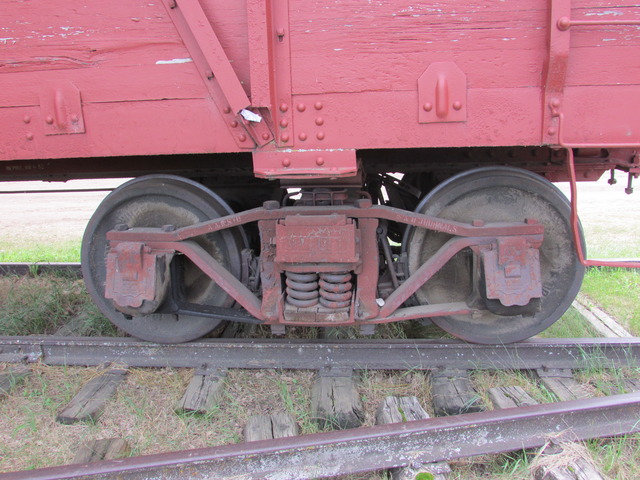
Designed by CPR master car builder W. E. Fowler, these wood single-sheathed steel frame boxcars had a capacity of 40 tons and a tare weight of 20 tons and 2,448 cubic feet of space. They were outfitted with archbar Simplex trucks. 


Prior to the Fowler design, boxcars typically had wooden structural members sandwiched between an interior and exterior wooden skin. The Fowler car eliminated the exterior layer, producing a cheaper, lighter car that could carry a greater payload.


This design also prevented grain leakage at the seam between the floor and the side of the car. 

The cars were loaded through the door of the car, which was “coopered” with wood planks; a pipe was inserted through the top to fill the car.

Later, the in 1950s, cardboard was used to replace the wood planks.

Since different crops have different weights, lines and the names of the various grains are stenciled on the inside of the car at the Museum—and I assume on all of the Fowler cars.


For unloading, the planks or cardboard sheets were removed so the grain could run out. Men with shovels scooped the remaining grain out of the cars.


The first cars built had wooden roofs and doors, but later cars had stamped steel roofs and corrugated steel doors. Cars were often rebuilt so early cars could appear with steel roofs and doors or any other combinations.

The Museum’s car was donated by the CPR in 1977.


As the Museum puts it on its website: “Doubtlessly, 119462 is a veteran of many a fall grain ‘rush’ with countless trips to the Lakehead, the Pacific, Montreal and into the U.S.”

The car, it adds, has “earned its place at the Manitoba Agricultural Museum” and is “an interesting part of the story” of agriculture in Manitoba.

With information from the Manitoba Agricultural Museum, and the Toronto Historical Railway Society.  Also see OKthePK.

Thursday, September 22, 2016

What a Difference a Year Makes


What a difference a year makes!

The first photo shows what the N scale Thompson River Canyon layout looks like today. The second photo (below) is what it looked like last August.

Last year, I was able to complete one side of the layout before displaying it at the annual Manitoba Mega Train show.


This year, both sides are completed—again, in time for this year’s Mega Train show, Sept. 24-25 here in Winnipeg.

It’s been a fun journey, and a meaningful way to remember my brother-in-law, who died in 2014 before he could build his own version of the Canyon (his favourite railfan location).

If you are in Manitoba, see you at the show!


Saturday, September 17, 2016

40-Foot Boxcar Grain Rush on the M & M Sub.


It’s harvest time on the prairies, and the grain rush is on.

This includes 40-foot boxcars in grain service on the early 1990s-era CP Rail Manitoba & Minnesota Sub.
For decades, the 40-foot boxcar was the mainstay of grain handling in Canada.

But by the early 1990s, the era the M & M Sub. is set in, the famous “Trudeau hoppers” have taken over the bulk of railway grain handling in Canada.


The 19,000 cars, first introduced in 1972, were sponsored by the Government of Canada and manufactured by Hawker-Siddeley, National Steel Car and Marine Industries.

They took their nickname from Pierre Elliot Trudeau, Prime Minister at the time.

Although most grain moves in the new hoppers, there are still light branchlines in Manitoba, Saskatchewan and Alberta that can’t handle these heavier cars. So it’s the classic 40-foot boxcar to the rescue.


By the early 1990s, there were still over 300 40-foot boxcars still in grain service. These were cars that, like the cylindrical hoppers, benefitted from government help.

In 1979-80, when there were still about 13,000 40-foot boxcars in operation for grain handling, they were upgraded with new floors, nailable door areas, sliding door repairs, and painting.

A yellow wheat sheaf was applied to the left of the door with an acknowledgement of the government’s assistance in English and French.


My 40-foot grain handling fleet is a hodge-podge of cars from various manufacturers. There is almost nothing remotely prototypically accurate about most of them; my goal was the overall affect.

Some were painted and lettered by me, others came ready-to-run. I applied the chevron from CDS on the side of each car. 


The cars make a great sight each fall on the M & M Sub., carrying grain from the prairies to ports on Lake Superior.

Click here to visit Trackside Treasure to learn more about CP Rail’s 40-foot grain handling boxcars, and click here to learn more about the boxcars on CN.

Click here to see a video of my 40-foot boxcar grain train in action on the layout.


Prototype photos on this page from Trackside Treasure.

Thursday, September 15, 2016

Huge HO Scale Collection for Sale


Someone posted this on the Canadian Railway Modellers Facebook Page—an amazing collection of HO scale rolling stock, locomotives and other items for sale on Craigslist.


According to the seller, who lives in Salmon Arm, B.C., the items are the result of 40 years of collecting. The pictures, he (or she) says is "only a small portion of the collection."

Contact is only by phone; no e-mail or texts. You can find more photos and info, including contact info, here.

Anyway, even you aren't going to buy anything from this seller, you can sure enjoy looking!